
Folk Craft / Mingei
Yanagi Soetsu and the Birth of Mingei — What Did He Actually Find?
The Philosophy of Mingei · Part 1 of 12
MONO/The Tangible Stillness | MEGURU STILLNESS JAPAN

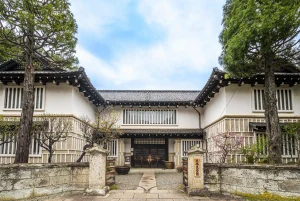
In a quiet corner of Tokyo’s Komaba neighborhood stands a low, dark-timbered building that most visitors walk toward without quite knowing what they will see. Inside, the rooms are lit softly, and the objects are ordinary on purpose: rice bowls, storage jars, woven baskets, indigo-dyed cloth. Many of them carry no maker’s name at all. They were made by people who never expected to be remembered, for households that expected nothing more than to use them.
This is the Japan Mingei Museum, and it exists because of a single idea: that the most trustworthy beauty may be the kind that never set out to be beauty at all. The man who first put that idea into words was a philosopher, not a potter.
I. A Man Who Learned to Look
Yanagi Soetsu was born in Tokyo in 1889, and he did not begin as a champion of folk craft. As a young man, he belonged to the Shirakaba circle, a group of writers and thinkers whose magazine introduced Japanese readers to Western artists such as Rodin and the Post-Impressionists. His own early writing turned to the English poet and artist William Blake. His first passion was for the visionary, the individual genius, the artist who stood apart.
That detail matters. What Yanagi later found, he found as someone trained to look hard at art and to distrust easy admiration. The turn in his thinking was not the enthusiasm of an outsider to beauty. It was the revision of an insider’s assumptions.
II. A Jar From Korea
The first turn is usually traced to 1914, when a friend gave him a porcelain jar from Korea’s Joseon dynasty. By his own later account, it changed how he looked at objects. The jar had no signature and no claim to genius. It had been made by potters working in a long tradition, for ordinary use, and yet it held a quiet confidence that the celebrated works he had studied did not always have.
From that point, Korean ceramics became one of his lifelong subjects. He also wrote in defense of Korean culture at a time when Japan’s colonial policies threatened parts of it, including a well-known essay opposing the demolition of a historic palace gate in Seoul. His interest in the beauty of everyday objects was never separate from a moral interest in the people who made them.
III. The Monk Who Carved Buddhas
The second discovery came closer to home. In 1924, in Yamanashi, Yanagi encountered the carvings of Mokujiki, an eighteenth-century wandering monk who had traveled across Japan carving Buddhist figures in a plain, rounded, startlingly gentle style. Mokujiki had no academic training and no reputation among connoisseurs. His statues were, by the standards of the established art world, unremarkable.
Yanagi saw in them something that formal training could not produce: a beauty that came from sincerity and repetition rather than ambition. It confirmed what the Korean jar had suggested. The most moving work might come from the people the art world never thought to ask.
IV. Giving the Thing a Name
In 1925, Yanagi and two potters, Hamada Shoji and Kawai Kanjiro, are said to have coined a word for what they had been circling: mingei, a contraction of minshuteki kogei, “the crafts of the common people.” The coinage may sound modest. It was not. A name is a way of seeing, and once these objects had one, they could be collected, studied, argued over, and defended.
The movement that followed built a museum, which opened in Tokyo in 1936, and a network of kilns and workshops across the country. But the deeper achievement was the naming. Before it, a worn rice bowl was merely a rice bowl. After it, it could be a question.
V. What He Actually Found
It is tempting to summarize Yanagi’s discovery as a taste for the rustic or the charmingly simple, and that summary misses nearly everything. His claim was stronger: that objects made for use, in quantity, by anonymous hands working within a living tradition, can possess a beauty that self-conscious art often struggles to reach — and that this beauty is not accidental but the natural result of how such objects are made.
This single claim opens onto everything the rest of this series will explore: the beauty of use, the unknown craftsman, the role of region and material, the relationship between maker and user. It is also a claim that can be questioned, and later parts of the series will do so. But before any of that, it is worth sitting with the shock of the original insight: that the thing you eat from every morning might be worth looking at.
VI. A Conviction With Cousins
Readers in North America and Britain may recognize pieces of this conviction. Yanagi knew and admired the Arts and Crafts movement, whose figures such as William Morris believed that industrial production had cost something worth recovering. In North America, Shaker communities made furniture and boxes valued for their plainness, usefulness, and careful construction, and that tradition is admired for much the same reasons.
The traditions are not identical. Broadly, Morris sought to revive craft through deliberate design, while Yanagi looked for beauty in objects made by people who never thought of themselves as designers or artists at all. But the shared instinct is easy to recognize: that a handmade, well-used thing can carry a dignity that a fast, anonymous, disposable one often does not.
Yanagi did not discover a style. He discovered that a person could learn to see what had been in their hands all along.
Further Reading — In Yanagi’s Own Words
The Unknown Craftsman: A Japanese Insight into Beauty
Soetsu Yanagi, adapted by Bernard Leach. A classic English-language introduction to Yanagi’s thinking.The Beauty of Everyday Things
Soetsu Yanagi, translated by Michael Brase. A more recent collection of his essays

Comments