
抹茶 / Matcha
Where the Green Comes From
KOTO/The Intangible Resonance | MEGURU STILLNESS JAPAN
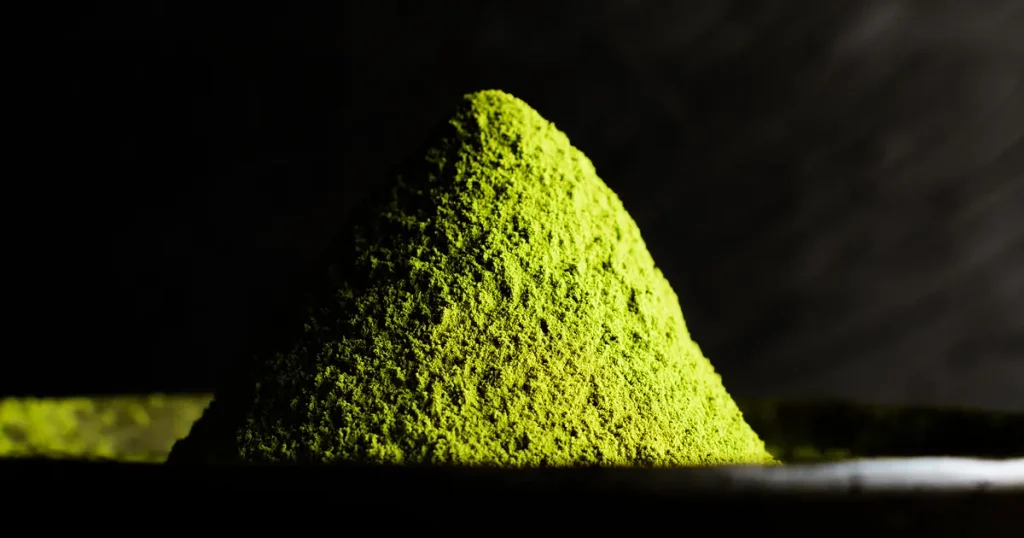
In late April, the tea fields look like they have been put to bed. Long rows of bushes that were open to the sky a few weeks ago are now covered by dark canopies, stretched low over the plants so that the light reaching the leaves is a fraction of what it was. Walk beneath one and the world changes. The air is cooler and quieter. The leaves, pressed against the dimness, are an unusually deep green.
This is the beginning of matcha, and it does not happen in a mill or a tea room. It happens here, in a field, over about three weeks, in a slow and deliberate withholding of light.
I. A Leaf Raised in the Shade
Matcha is not simply green tea ground into powder. The leaf it comes from, tencha, is grown differently from the start. Shading the bushes for roughly three weeks before harvest slows their growth and changes their chemistry, leaving leaves that taste rounder and more savory, with less of the sharpness of ordinary sencha. Those leaves are then steamed and dried, spread out flat, not rolled, which keeps them in a form that can later be ground.
The tradition of shading, called ooishita saibai, is a form of patience practiced on a living plant. Everything about the finished bowl is already decided by what happens in the weeks when nothing seems to be happening.
II. Uji, Where the Tradition Settled
Tradition traces tea in Japan back to Zen monks who brought seeds and the practice of whisked powdered tea home from China around the twelfth century, and to temples that tended the earliest gardens. From that beginning, the area around Uji, south of Kyoto, became the heart of Japanese tea culture. Its river mists, its mild slopes, and its centuries of accumulated knowledge made it the place where shaded cultivation was refined into a craft.
For anyone who has read about the tea room elsewhere in this series, this is the landscape behind it: the fields that supplied the leaves for the rooms where wabi was refined.
III. A Map Being Redrawn
Uji is not the only place matcha comes from. Nishio, in Aichi Prefecture, is another long-established center of production, and Kyoto Prefecture as a whole has been reported to account for roughly a quarter of Japan’s tencha. But the map is shifting. As global demand has grown, farmers in other regions, including Kagoshima and Shizuoka, have been turning fields over to tencha, and national production has risen sharply — reported figures put it at more than two and a half times what it was a decade earlier.
A crop with a centuries-old home is, for the first time in a long while, finding new ones.
IV. The Patience of the Stone Mill
Once the tencha leaves are dried and sorted, they are ground, and in the traditional method that means a granite stone mill turning slowly. It produces only a few dozen grams of powder in an hour. The slowness is not a flaw. It keeps the heat of friction low, so that the delicate flavor and the bright green color of the leaf are not scorched out of it on the way to becoming powder.
There is a small, quiet lesson in this: that the pace at which something is made is sometimes part of what is being made.
V. A Crop That Cannot Be Hurried
The recent matcha boom has brought this slowness into sharp relief. Reports in 2025 described record heat in Kyoto the previous summer weakening tea bushes and reducing the spring harvest, while demand kept climbing, and prices at the Kyoto tencha auction rose to record levels. Shading, steaming, drying, and milling cannot be sped up on demand, and a tea bush is not a crop that can be replaced in a season.
When a bowl of good matcha is expensive or hard to find, it is worth remembering what stands behind that scarcity: years of a plant’s life, three weeks of managed darkness, and a stone that turns at its own speed.
VI. One Leaf, Many Doors
For many readers in North America, the first encounter with matcha is a latte at a neighborhood café, and there is nothing lesser about that door. It has introduced a great many people to the flavor of shaded tea, and to curiosity about where it comes from. The bowl whisked in a tea room and the cup ordered on a weekday morning begin in the same field, under the same canopy, with the same three weeks of shade.
Knowing where the green comes from does not change the drink. It changes the attention you bring to it.
Matcha is not a green powder. It is three weeks of shade, one patient stone, and a field that cannot be hurried.
What in your own life is still growing in the shade, and what would it mean to let it take its full time?


Comments