下座行 / Gezagyo
The Ma of Cultivating Humility
KOTO/The Intangible Resonance | MEGURU STILLNESS JAPAN
Gezagyo
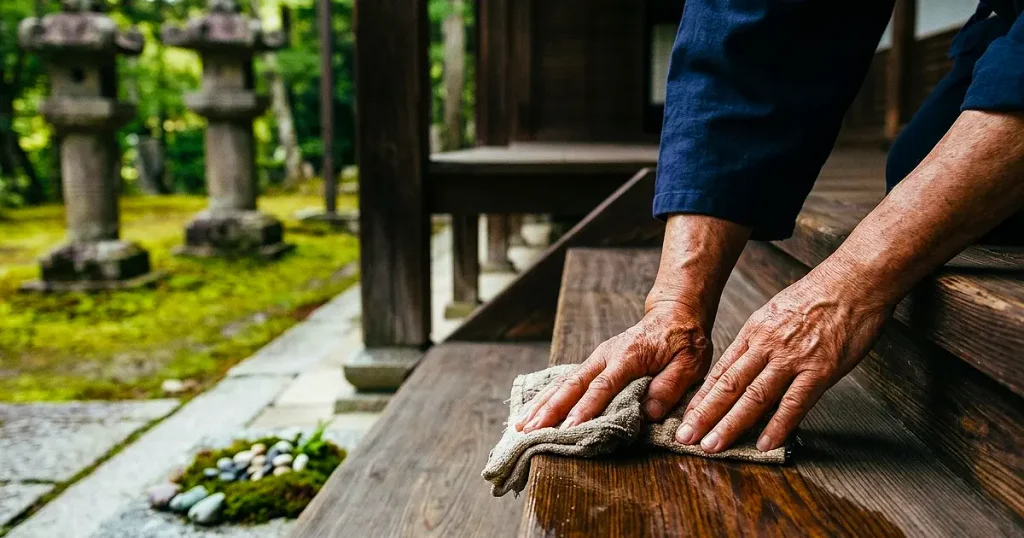
“Geza-gyō ” is a form of spiritual discipline found in Buddhism and Japanese traditions in which one places oneself in a position or environment lower than others—such as by voluntarily taking on menial tasks or cleanup duties—and devotes oneself wholeheartedly to the work without complaint, thereby refining one’s character.
It entails deliberately accepting a role or position—such as handling chores or tidying up—that is several levels below one’s actual ability or true worth.
As people rise in status or age, they are prone to arrogance; this practice serves as a foundation for shattering that pride and cultivating a humble heart.
Although the term itself is becoming less common in modern Japan, the practice of cleaning—whether in a temple training hall or in daily life—remains a prime example of this discipline; the act of organizing one’s environment is believed to lead to the ordering of one’s own mind, helping to clear away distracting thoughts and worldly attachments.
Before dawn, a monk who has trained for decades — someone whose teaching, in another context, younger monks would travel long distances to receive — is scrubbing a stone floor on his hands and knees. The task is the toilet. The attention he brings to it is identical, in quality, to the attention he would bring to sitting meditation: unhurried, complete, without a trace of resentment at the assignment.
I. What the Lower Seat Actually Means
Gezagyo, literally “lower-seat practice,” refers to the deliberate act of taking on the least prestigious, most physically humbling tasks as a form of spiritual training — not as punishment, and not as a hazing ritual to be endured before real training begins, but as training in its own right. It differs from kenson, the culture of humble speech and self-effacing language explored elsewhere in this series, in one crucial way: gezagyo is cultivated through the body, not through words. It is humility enacted in labor rather than spoken in a sentence.
II. “Tosu” The Sanctified Toilet of a Zen Monastery
In traditional Zen monasteries, the toilet is known as tosu, and it is treated as one of three places — alongside the bathhouse and the meditation hall itself — where absolute silence and complete seriousness are required at all times. This is not squeamishness about the task. It is the opposite: a structural insistence that the quality of attention a practitioner brings to the lowest physical task must match, without exception, the attention brought to formal meditation.
If a practitioner’s focus wavers the moment a task stops being dignified, the argument goes, then the focus was never truly stable in the first place — it was conditional on status, which is precisely what gezagyo is designed to dismantle.
III. The First Task Given at a New Company
A secular echo of this logic survives in Japanese corporate apprenticeship. New employees, regardless of the prestige of the university they graduated from or the seniority they are ultimately destined for, are often assigned the most basic tasks first — cleaning the office, serving tea to clients and superiors, running photocopies. This is rarely framed as inefficiency or wasted talent.
It is understood instead as a deliberate first chapter — a period in which a new employee’s relationship to the organization is built from its lowest point upward, before any authority is extended to them at all.
IV. Why Starting at the Bottom Cultivates Ma
This deliberate period at the bottom functions as a structural pause in the shape of a career or a spiritual path — much like the held beats explored elsewhere in this series, except stretched across months or years rather than seconds. It is an interval placed before status is granted, not after, ensuring that whatever authority eventually arrives is built on a foundation that already understands what it feels like to hold none.
Remove this interval — grant authority immediately, without ever requiring the lower seat — and what results is a status that was never tested against the specific discomfort gezagyo is built to teach: that a person’s worth does not fluctuate based on how prestigious their current task happens to be.
V. The Truly Humble Keep Choosing the Lower Seat
What separates genuine gezagyo from a mere rite of passage, endured once and never repeated, is what a practitioner does after status has already been secured. The monk scrubbing the tosu floor in this piece’s opening scene is not a novice working through a required phase. He has every standing required to delegate the task entirely, and continues choosing not to.
This is the clearest evidence available that the practice worked as intended. A humility that disappears the moment it is no longer required was never Gezagyo in the first place — it was simply patience, waiting out its turn.
VI. A Discipline Recognizable in Other Traditions
The instinct behind gezagyo is not confined to Japan. Professional kitchens have long held to a version of the same logic — chefs destined for their own restaurants often begin in the dish pit, not because the work requires rare skill, but because enduring it is considered foundational to everything that follows. Certain Christian monastic traditions built manual, often menial labor directly into their rule of life, treating humble work and prayer as inseparable rather than as separate categories of virtue.
What differs, again, is not the presence of the instinct but how systematically it is built into formal training. Gezagyo treats the lowest task as indistinguishable in importance from the highest — a conviction that appears, in different clothing, wherever serious traditions have asked what it actually takes to build character rather than merely credentials.
He had every right to delegate the task. That he chose not to is the only proof that the practice ever worked.
Is there a task you have outgrown the need to perform yourself that you might still choose to do, simply to remember what it teaches?







Comments