千利休 / Sen no Rikyu
The Man Who Perfected Wabi
KOTO/The Intangible Resonance | MEGURU STILLNESS JAPAN
Sen no Rikyu
Sen no Rikyu was a tea master who was active from the Sengoku period to the Azuchi-Momoyama period.
He is also famous as a tea master who pursued and perfected a style of tea ceremony called “Wabicha,” which eliminates waste to the utmost.
The descendants of Sen no Rikyu are known as the Three Senke Schools of Tea Ceremony (Omotesenke, Urasenke, and Mushakoji Senke), which continue as schools to this day.
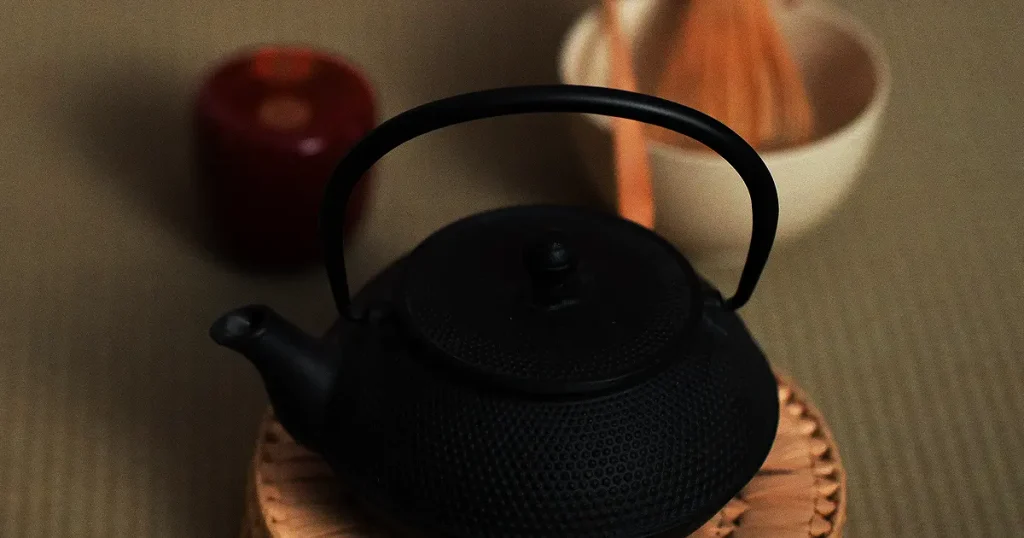
The teahouse he finally arrived at measures roughly two tatami mats — barely enough floor space for two people to sit facing each other, let alone move. The entrance is a crawling door, nijiriguchi, so low that everyone who enters, regardless of rank, must bend forward and duck through it. A samurai wearing a sword cannot fit through carrying it. He has to leave his status at the threshold, literally, before he can sit down.
I. An Aesthetic Born in a Merchant’s House
Sen no Rikyu was not born into the aristocracy, and this fact matters more than it might first appear. He came from a merchant family in Sakai, a wealthy trading port near present-day Osaka, in an era when tea culture had largely belonged to the court and the warrior elite. That an aesthetic philosophy capable of reshaping an entire nation’s sense of beauty emerged from a merchant’s household, rather than a palace, was unusual enough on its own.
II. A Tea Master in the Service of Power
Rikyu’s aesthetic rise did not happen apart from power — it happened directly inside it. He served first as tea master to Oda Nobunaga and later to Toyotomi Hideyoshi, two of the most consequential figures in the unification of early modern Japan, during an era when a shared bowl of tea could function as a diplomatic negotiation, a political alliance, or a display of loyalty as much as an aesthetic occasion.
There is a real tension worth sitting with here: a philosophy built entirely around restraint, humility, and the stripping away of excess was being shaped, refined, and spread by a man operating at the absolute center of wealth and military power. Rikyu did not develop wabi in isolation from power. He developed it inside the room where power was being exercised.
III. A Teahouse That Kept Shrinking
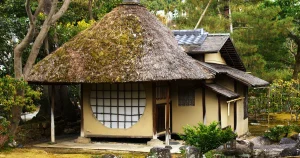
Over the course of his career, Rikyu’s tea rooms grew smaller, not larger — a trajectory that ran directly against the instinct of a man whose patrons were among the wealthiest and most powerful in the country. His surviving masterpiece, Taian, a National Treasure that still stands at Myokian temple in Kyoto, condenses the tea ceremony down to its most minimal possible stage: two tatami mats, unfinished clay walls, a single small window admitting carefully limited light.
The contrast with his own era becomes sharpest when placed beside another structure built during the same years: Hideyoshi’s portable golden tea room, its walls, pillars, and utensils gilded entirely in gold leaf, designed to be disassembled and carried from castle to castle as a display of absolute wealth. Rikyu, by most historical accounts, served tea inside that gold room too, as his position required — the same man responsible, within the same years, for building both the most opulent teahouse Japan had ever seen and the most austere one.
IV. Where Conviction Met Power, and Ended in Death
In 1591, Hideyoshi ordered Rikyu to commit seppuku. The exact reason remains genuinely contested among historians, and this site will not pretend to settle what scholarship itself has not settled. Proposed explanations range from a wooden statue of Rikyu placed above a temple gate Hideyoshi was said to walk beneath, to accusations of profiteering from the tea utensil trade, to a deeper and more plausible political rupture between a ruler demanding ever more displays of submission and a tea master whose aesthetic authority had, by then, grown large enough to rival his patron’s own.
What can be said with more confidence is this: a philosophy of subtraction, humility, and restraint had, by the end of Rikyu’s life, grown powerful enough to be perceived as a threat by the single most powerful man in the country. Smallness, in his hands, had stopped being merely an aesthetic position and become something closer to a form of authority in its own right.
V. An Aesthetic of Subtraction, Perfected
Rikyu’s enduring legacy is not any single object, teahouse, or utensil, but a method: a disciplined, lifelong practice of asking what could be removed rather than what could be added. Wabi-cha, the style of tea ceremony most closely associated with him, treats a cracked bowl, an unglazed wall, and an uncomfortably low doorway not as compromises but as the clearest possible expression of beauty — the same instinct explored elsewhere in this series, applied by one man with enough conviction and enough proximity to power to make it the dominant aesthetic of an era.
VI. A Conviction Recognizable Beyond Japan
The instinct Rikyu spent his life refining is not entirely foreign to Western ears. Twentieth-century modernist design built its own version of the same conviction around the phrase “less is more,” stripping ornament away from buildings and objects in pursuit of a clarity that excess was seen to obscure. Rikyu arrived at a related insight roughly four centuries earlier, inside a two-tatami room, under very different pressures and for very different reasons.
The two did not arrive at the same conclusion by the same path, and collapsing them into a single idea would flatten what is specific to each. But the recurrence itself is worth noting: when humans are given enough conviction and enough room to think, subtraction keeps reappearing, in very different centuries, as a serious answer to the question of where beauty actually lives.
He did not make the tea room small because he had nothing left to add. He made it small because he understood, finally, what to take away.
An original reflection by this site, not a historical quotation attributed to Rikyu.
What in your own life have you been trying to improve by adding to it, when the real answer might be found in what you’re willing to take away?

Comments