二礼二拍手一礼 / Nirei Nihakushu Ichirei
The Ma Held Inside Two Bows and Two Claps
KOTO/The Intangible Resonance | MEGURU STILLNESS JAPAN
Nirei Nihakushu Ichirei
Here is the basic etiquette for visiting a shrine.
Each step of the ritual has specific meaning; for instance, clapping is said to invite the deity’s presence and ward off evil spirits. It is not merely a casual clap, but a respectful gesture performed with sincerity to honor the deity.
1. Offering
First, stand in front of the offering box. Remove your hat and set down any luggage you may be carrying. Next, bow slightly and make your offering. Place the offering gently into the box rather than tossing it in.
2. Two Bows
Stand with good posture and bow deeply twice. Lower your head firmly, bringing your palms down to cover your knees (an angle of approximately 90 degrees is the standard).
3. Two Claps
Bring your palms together at chest height. Shift your right middle finger down to align with the second joint of your left middle finger, then open your hands parallel to shoulder width and clap slowly twice. After the second clap, bring your palms together again to offer your prayer.
4. One Bow
Finally, bow deeply once, offer a slight bow, and then step back.
There are various theories regarding the origins of the “two bows, two claps, one bow” ritual.
It is said to stem from the term “two bows, two claps” found in a document titled *Shrine Rituals* (Jinja Saishiki), issued by the Ceremonial Bureau of the Imperial Household Ministry.
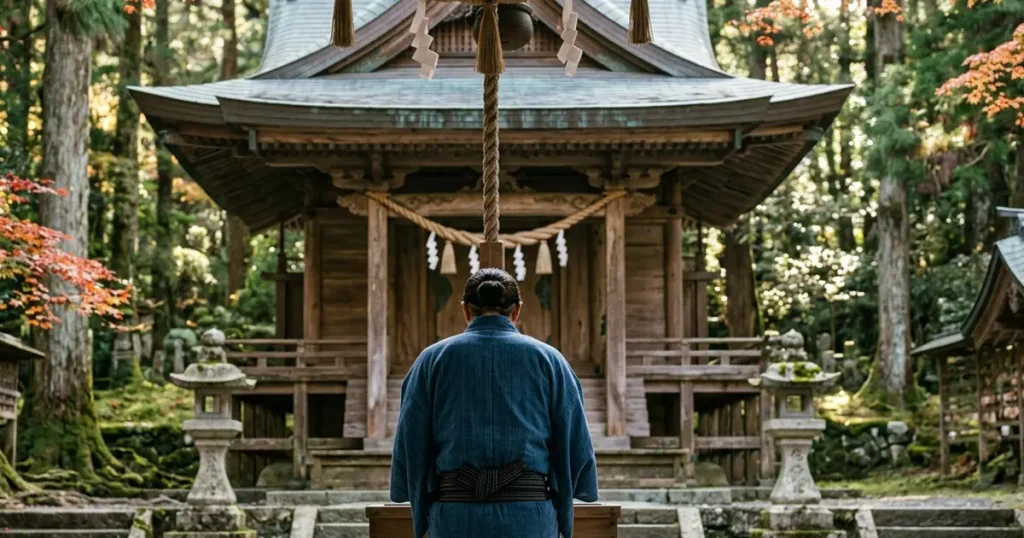
At the top of the stone steps, in front of the honden, a worshiper stops walking. He does not stop because anything is blocking his path. He stops because this is where the sequence begins, and the sequence has a fixed order that does not tolerate being rushed into: bow, bow again, clap twice, hold the hands together, then one final bow before stepping back.
Between the second clap and the final bow, there is a stretch of time with no prescribed motion attached to it at all. His hands stay pressed together. His eyes may or may not be closed. Nothing about his posture changes. And yet this unmarked interval is, by most accounts, the actual center of the entire visit — the part the rest of the sequence exists to arrive at.
I. The Four Pauses Inside a Fixed Form
Nirei nihakushu ichirei — two bows, two claps, one bow — is one of the most standardized sequences in Japanese religious practice, taught the same way at shrines across the country. What is less often pointed out is that the sequence is not really four actions performed back to back. It is four actions separated by pauses of distinctly different character: a settling pause after the first bow, a gathering pause after the second, a resonant pause between the two claps, and finally the open, undirected pause after the hands come together.
Each pause is doing different work, even though none of them involves visible movement. Treating them as interchangeable — or worse, as one continuous blur to move through as quickly as possible — collapses a structure that was built, quite deliberately, to slow a person down in stages.
II. Deciding What to Pray For, Inside the Pause Itself
The final, unstructured pause is where something genuinely open-ended happens inside an otherwise rigidly defined form. There is no set text to recite, no required content for what passes through a visitor’s mind during it. Some use the moment to voice a specific wish. Others simply stand in acknowledgment of the place, with nothing particular in mind at all.
What makes this interesting is the order of operations: the form comes first, entirely fixed, and only once it is complete does the pause open up a space for something personal to occupy. The structure does not dictate the content of the prayer. It simply makes sure a space for one exists at all, held open by everything that came before it.
III. The Quiet Before the Bell and the Coin
Before any of the bows begin, there is an earlier, smaller pause that is easy to overlook entirely: the moment just before a coin is dropped into the offering box and the bell rope is rung. Visitors rarely toss the coin the instant they arrive. There is, almost universally, a brief settling — a breath, a straightening of posture — before the hand actually moves.
This tiny pause receives almost no attention in explanations of shrine etiquette, and yet it functions as the transition point where a visitor stops being merely a passerby and becomes, for the length of the ritual, a participant in it.
IV. Why the Pause Cannot Exist Without the Form
It is worth asking why this pause carries any weight at all, given that a person could, in principle, simply stand quietly in front of a shrine without performing any of the surrounding sequence. The answer is that an undefined silence and a defined pause inside a known structure are not the same experience, even if they look identical from the outside.
A pause only registers as a pause because something with a defined shape came immediately before it and something with a defined shape will come immediately after. Remove the two bows and two claps entirely, and the silence that follows is no longer functioning as ma — it is simply someone standing still, with nothing marking where the stillness begins or where it is meant to end.
V. A Pause Many Traditions Already Recognize
A reader encountering this sequence for the first time may find it more familiar than it first appears. North America keeps its own version of a form built specifically to hold an open, undirected pause: the moment of silence observed at a memorial service, the brief stillness before grace is said at a table, the held breath of a stadium before a tribute begins. None of these share the shrine’s specific choreography, and none need to. What they share is the same underlying instinct — that some moments of meaning are better held in silence than filled with words, and that silence lands more fully when something with a clear shape has framed it first.
Recognizing this shared instinct does not make the two traditions the same, and it does not need to flatten what is specific to either one. It simply means that a visitor standing at a shrine for the first time, unfamiliar with every step of the sequence, is not encountering something wholly foreign. They are likely encountering a familiar human impulse, expressed through an unfamiliar form.
VI. A Pause That Can Be Felt Without Being Understood
Someone standing nearby who does not know the exact sequence — who could not name nirei nihakushu ichirei or explain what each part is called — can usually still sense, without being told, that something is taking place that deserves a moment of quiet from anyone standing close enough to notice. The specific mechanics of the ritual can remain entirely unknown, and its central pause can still communicate itself.
This may be the clearest proof available that ma is not a piece of cultural trivia to be explained, but something closer to a frequency the body recognizes on its own, once it has been given a form quiet enough to carry it.
The bows and claps are not the prayer. They are the frame that makes a silence worth having.
What form in your own life exists mainly to make room for a silence you would not otherwise permit yourself to have?



Comments