所作 / Shosa
The Body’s Way of Holding Ma
KOTO/The Intangible Resonance | MEGURU STILLNESS JAPAN
所作 / Shosa
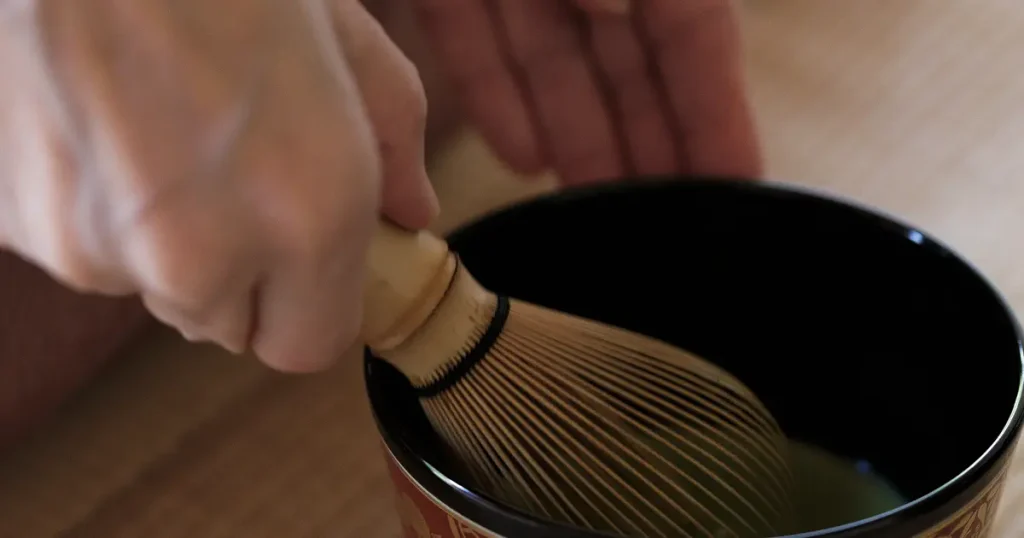
Shosa refers to the way one moves the body to perform everyday actions—such as standing, sitting, and general physical conduct—with beauty and grace.
Unlike mere formal etiquette or casual gestures, shosa represents a natural physical expression of thoughtfulness and respect for others.
The fundamental approach involves performing even simple, routine actions—such as walking, sitting, picking up an object, or handing something to another person—slowly, carefully, and with a deliberate pause.
In disciplines such as the tea ceremony, ikebana (flower arranging), traditional Japanese dance, and Kabuki, shosa—practiced in the form of codified patterns (kata)—has long been cherished as the most direct way to convey one’s inner spirit.
The business card is offered with both hands, held at its two top corners, text facing the receiver so it can be read the instant it is taken. The receiving hands mirror the gesture exactly — both of them, corners held the same way — and for a moment, neither person moves. The card is looked at. Read, in effect, before it is truly held.
Only after that beat does the card get lowered, glanced at once more, and placed somewhere deliberate — a card case, a spot on the table where it will remain visible for the length of the meeting. A foreign visitor who takes the card in one hand and pockets it immediately has broken no explicit rule. And yet something has clearly gone missing.
I. Not the Movement, But the Seam Between Movements
Shosa is often translated as “comportment” or “bearing,” but both words point toward posture — how a body is held — when the more precise subject is how a body moves from one position to the next. What separates practiced shosa from mere physical competence is rarely the individual gestures themselves. A bow is a bow; most people can approximate the angle after watching it once. What is much harder to imitate is the seam between one movement and the next — the held beat before the card is lowered, the pause before a bow begins to rise back up.
II. Standing Up From Seiza, One Held Beat at a Time
Watch someone trained in traditional manners rise from seiza, the formal kneeling position, and the motion looks deceptively simple — smooth, continuous, over in a second or two. Watch it closely enough, though, and it resolves into several distinct, briefly held positions rather than one fluid arc: weight shifted forward, a pause; one foot drawn beneath the body, a pause; the rise itself, controlled rather than launched.
To an untrained eye, these pauses are invisible — absorbed into what looks like a single smooth action. To a trained eye, removing them is precisely what makes a movement look rushed, even when its overall shape and speed are nearly identical to the version performed correctly.
III. The Small Ceremony of the Business Card
Return to the card exchange from the opening scene, and its logic becomes clearer. The pause before lowering the card is not decoration. It communicates, wordlessly and immediately, that the person handed to you is being given your full attention before anything else happens — before the card is filed away, before the conversation moves on to its actual business.
Skip that pause, and the card is still technically received correctly. But the specific message the pause was built to carry — attention paid before efficiency resumes — never arrives. The rule was followed. The shosa was not.
IV. Something Settled Into, Not Something Explained
Shosa is rarely taught through verbal instruction alone, and this is not an accident of pedagogy. Traditional apprenticeship in Japan — in tea ceremony, in craft workshops, in traditional theater — has long relied on minarai, learning by watching and repeating, rather than by being told the underlying rule in words. A student may practice the same bow, the same rise from seiza, hundreds of times before a teacher offers any verbal correction at all.
This makes sense once the pause itself is understood as the real content being taught. A rule can be stated in a sentence. A held beat, timed correctly in the body rather than the mind, generally cannot — it has to be repeated until it settles into muscle memory on its own terms.
V. A Rushed Shosa Is Not Shosa at All
Modern life is, almost by definition, hostile to held beats. A bow performed while already turning to leave, a card exchanged mid-stride, a greeting compressed to fit inside a five-minute meeting that was scheduled for fifteen — all of these preserve the outward shape of the gesture while quietly discarding the pause that gave it meaning.
This is why a rushed shosa is not simply a lesser version of the real thing. It is, in the sense that matters most, not shosa at all — the same body, moving through the same positions, having quietly stopped saying what those positions were built to say.
A bow can be copied in a single glance. The pause inside it takes years to actually mean something.
Where in your own daily movements have you let a necessary pause quietly disappear in the name of speed?




Comments