挨拶語 / Aisatsugo
The Ma Before Language
KOTO/The Intangible Resonance | MEGURU STILLNESS JAPAN
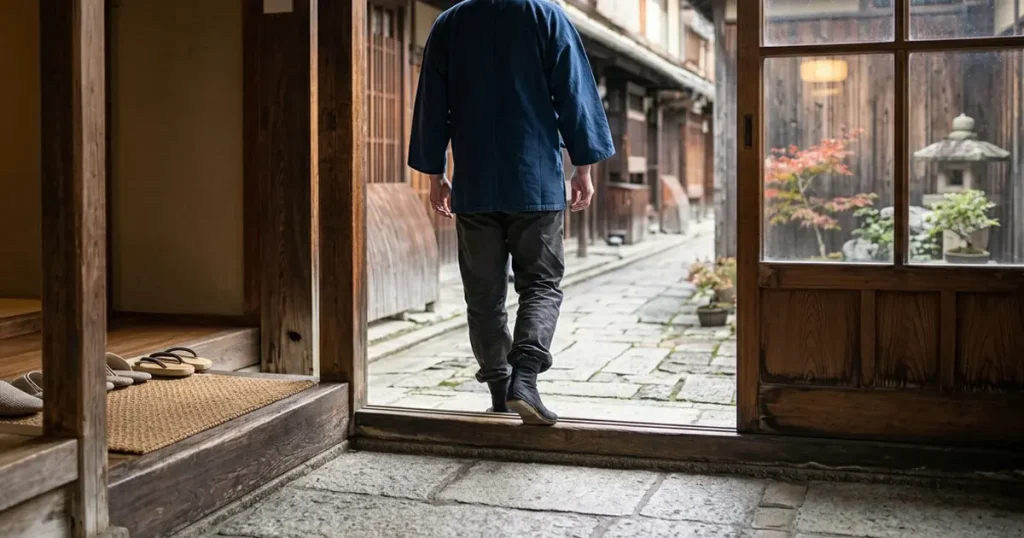
At the front door, a man calls out “itte kimasu” to no one in particular, or to whoever happens to be home. The words translate, roughly, to “I’ll go and come back” — a sentence that tells the household nothing it doesn’t already know. He is visibly leaving. Everyone present can see him putting on his shoes.
A voice answers from another room: “itterasshai.” Go, and come back safely. Again, nothing informative has been exchanged. And yet if the words are skipped — if he simply opens the door and leaves in silence — something about the moment registers as unfinished, even to people who could not explain exactly what went missing.
I. Words That Carry No Information
A great deal of everyday Japanese greeting language is, strictly speaking, informationally empty. Itte kimasu does not tell anyone something they did not already know. Tadaima, said upon returning home, announces an arrival everyone in the house can already hear. If these phrases are not delivering information, their function has to be something else entirely — and what they are actually doing, most of the time, is marking a boundary. They exist to draw a clear line between one state and the next: inside becomes outside, absence becomes presence, one phase of a day gives way to another.
II. Yoroshiku Onegaishimasu : A Pause That Resists Translation
No phrase illustrates this better than yoroshiku onegaishimasu, routinely listed as one of the hardest Japanese expressions to render into English. It is said at the start of a new working relationship, before a favor is asked, at the close of a business introduction — and its closest literal translations, “please treat me favorably” or “I humbly ask for your goodwill,” never quite land the way the original does.
What the phrase is actually doing is opening a pause before the content of a relationship begins — a verbal placeholder acknowledging that something is about to be asked, undertaken, or shared, without yet specifying what that something will require. English tends to skip straight to content: a request stated, a name exchanged, a project described. Yoroshiku onegaishimasu insists on a beat of acknowledgment first, before any of that content is allowed to start.
III. Itadakimasu and Gochisousama : Framing an Interval of Time
A meal in Japan is typically opened with itadakimasu — literally “I humbly receive” — and closed with gochisousama deshita, a phrase of thanks for the effort behind the food. Neither phrase describes the meal itself. Together, they function the way a wooden frame functions around a garden view seen through a window: not part of the scene, but the structure that tells you clearly where the scene begins and ends.
This is the same architectural logic behind the yukimi-shoji screen discussed elsewhere in this series, applied here not to a garden but to a stretch of time. A meal without these bookends does not stop being nourishment. It simply loses the clean edges that mark it as a deliberate occasion rather than a task performed in passing.
IV. The Break That Speaking Aloud Actually Creates
There is a further layer worth naming: these phrases do not merely describe a transition that is already happening on its own. Saying them is, in a real sense, what performs the transition. Tadaima is not a report filed after the fact of arriving home. Speaking it is part of how the arrival becomes complete, socially, in front of whoever is there to hear it — the way signing a document is not a record of an agreement but the act that finalizes one.
Silence in the same moment would not simply be a quieter version of the same event. It would leave the boundary unmarked — the arrival technically occurred, but never quite finished happening in the way it was meant to.
V. A Familiar Instinct, Expressed Less Systematically Elsewhere
English keeps its own scattered version of this same impulse, even without organizing it into a matched system the way Japanese does. “Safe travels” performs something close to itterasshai. Grace before a meal, in households that still observe it, opens the same kind of framed interval as itadakimasu. “Welcome back” answers an arrival much the way okaerinasai does. None of these carry much literal information either — the traveler already knows they are leaving, the family already knows dinner has arrived on the table.
What differs is density and consistency rather than the underlying instinct itself. Japanese has built a more complete set of these markers, covering more of an ordinary day’s transitions with more consistency than English typically bothers to. The impulse to mark a boundary with words rather than let it pass in silence appears to be something close to universal. Japanese simply gives it more room to live in.
Itte kimasu tells no one anything they didn’t already know. It is not information. It is the door itself, closing correctly.
What transition in your own daily life have you been letting pass in silence that might complete itself more fully with a word said aloud?





Comments