
炉開き / Robiraki
The New Year of the Tea Way
KOTO/The Intangible Resonance | MEGURU STILLNESS JAPAN
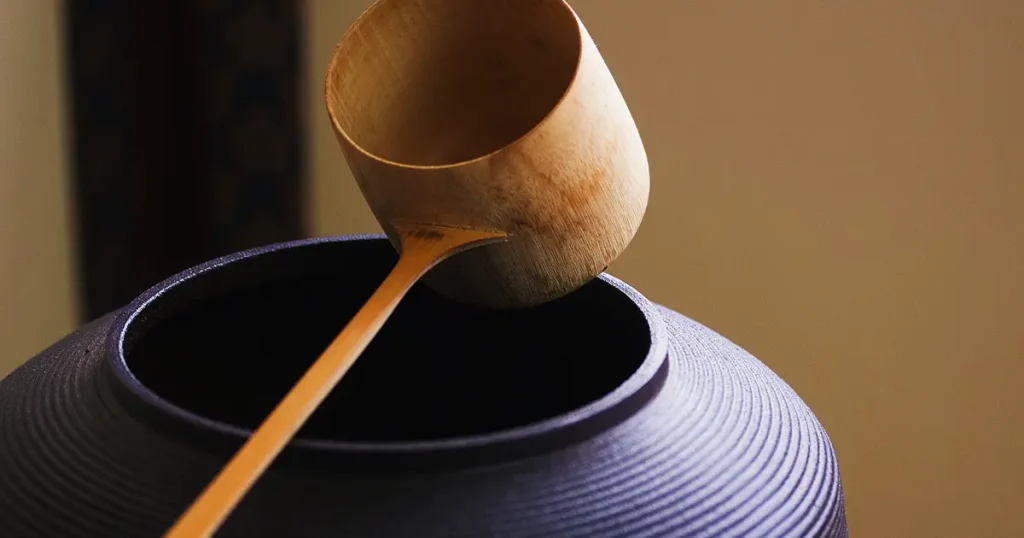
One panel of the tatami floor has been lifted away, and beneath it lies a square of ash, raked smooth and shaped by hand. For six months, this opening in the floor was covered over, as if it did not exist. This morning, a few pieces of charcoal are laid into the ash in a deliberate arrangement, and the first fire of the cold season is lit.
The guests arrive and sit closer to the center of the room than they did last month. An iron kettle is set above the new fire, and within a few minutes a faint sound begins to rise from it — a low, steady hush that tea people have long compared to wind passing through distant pines. Nothing has been said. And yet everyone in the room understands that a year has just begun.
I. A Year Divided Into Two Halves
The tea year does not follow the calendar year. It is divided instead into two distinct halves, each defined by where the water is heated. From roughly May to October, tea is made using the furo, a portable brazier set on top of the tatami — a small, raised fire suited to the warm months, placed deliberately far from the guests to keep the room cool. From roughly November to April, tea is made using the ro, a hearth sunk into the floor itself.
Robiraki, “the opening of the hearth,” is the moment the second half begins. Because it marks the true restart of the tea year’s rhythm, tea practitioners have long called it their own New Year — a beginning that arrives not in January, but when the first cold makes a fire necessary again.
II. The Lingering Before the Turn
A beginning cannot be fully felt without the ending that precedes it, and tea culture has given that ending its own name. Nagori no cha — the “tea of lingering” — is made in the final weeks of the furo season, when the stored tea of the passing year is nearly spent, and the air carries the first hint of the cold that will soon make the portable brazier unnecessary.
The feeling these gatherings are built around is not sadness exactly, but a particular tenderness toward something already beginning to leave. It is the emotional preparation that makes the lit hearth, a few weeks later, feel less like a mere change in equipment and more like a genuine arrival.
III. The Sealed Jar, Opened
Robiraki is often paired with another ceremony, kuchikiri, “cutting the mouth” of a sealed tea jar. The new tea picked in spring is stored in a tightly sealed jar through the hot months, allowed to mellow quietly in the dark. Only when the hearth is opened is the seal cut, and the leaves are finally ground into the first bowl of the new tea year.
Taken together, the two rites compose a single, deliberate act of timing: a fire that has been absent since spring, and a tea that has been waiting since spring, both returning to the room at the same moment. Neither arrives early. Neither is rushed.
IV. A Fire That Gathers the Room
The sunken hearth is a direct descendant of the irori, the open floor-hearth at the center of older Japanese homes, discussed in this series in connection with the kotatsu. Its logic is the same: warmth concentrated in one place, so that people are drawn toward it and, through it, toward each other. In the ro season, guests sit closer to the host than they did in summer, and the room itself reorganizes around a single glowing point.
This is hospitality understood as geometry. The host does not need to say a word of welcome; the arrangement of the room, centered on a fire that was dark a month ago, already does it.
V. A Beginning That Does Not Wait for January
Robiraki carries a quiet argument about what a beginning actually is. A beginning, in this view, does not belong to a date on a calendar. It belongs to a change in conditions — the moment the world around you shifts enough that a different way of living becomes necessary, and the ritual gives that shift a form.
This is the same turning that gives this journal its name, meguru: not a single moment of renewal, but a cycle in which each ending is already the preparation for the next beginning.
VI. A Second New Year, Familiar Elsewhere
Readers in North America may recognize this feeling without ever having attended a tea gathering. The first evening each autumn when the fireplace is lit — the particular smell of woodsmoke, the way a family drifts back into the room that has been quiet all summer — carries something very close to what robiraki ritualizes. So does September itself, which for anyone whose life has been shaped by school calendars feels, in some deep way, like the true start of the year.
The tea tradition does not invent this feeling. It simply insists that it is worth marking deliberately — that a year is allowed to have more than one beginning, and that the one tied to the first cold fire may be the truest of them.
The year does not begin when the calendar says so. It begins when the first fire is lit, and the room remembers how to gather.
What in your own life quietly begins when the cold arrives, long before any calendar says it should?

Comments