
精進料理 / Shojin Ryori
A Universe in Four and a Half Mats
KOTO/The Intangible Resonance | MEGURU STILLNESS JAPAN
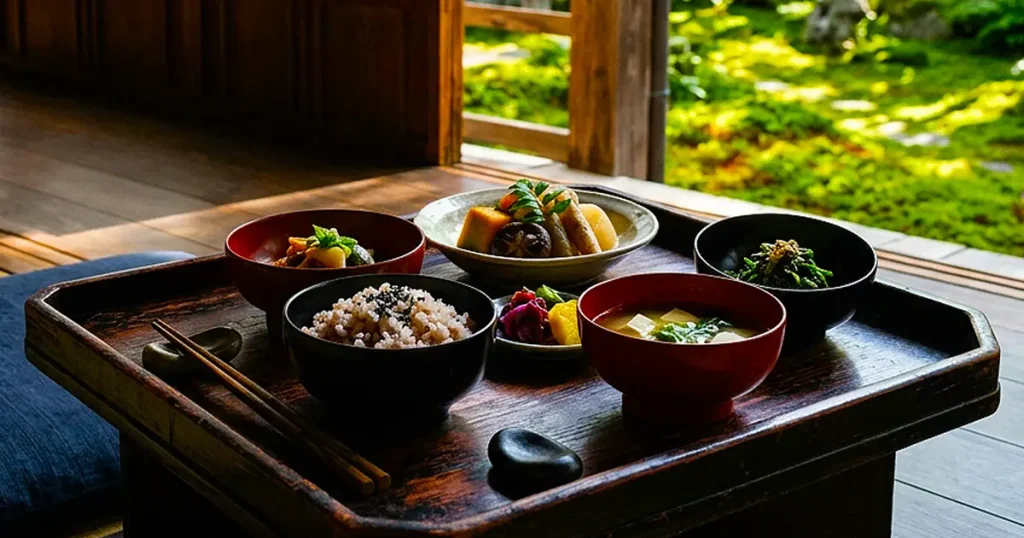
What is Shojin Ryori ?
Shojin ryori (Buddhist vegetarian cuisine) was introduced to Japan from China alongside Buddhism, and was later established as a uniquely Japanese style by Zen monks during the Kamakura period. Rooted in Buddhist teachings—which advocate against the taking of life—this cuisine contains no animal-based ingredients, such as meat, seafood, eggs, or dairy products. It is a traditional style of cooking designed to avoid stimulating worldly desires. The preparation emphasizes a balance of five basic flavors (sour, bitter, sweet, spicy, and salty), five cooking methods (raw, simmered, grilled, deep-fried, and steamed), and a harmonious use of color.
In the temple kitchen, long before the day’s first bell has finished echoing, a cook is slicing a radish. The knife moves at an even, unhurried pace. The peelings are set aside to be used later. A pot of water is already warming with a strip of dried kelp and a few dried mushrooms, and the cook does not hover over it, does not check it every thirty seconds. The pot is allowed to take the time it takes.
Nothing in this kitchen is performed for an audience. And yet the cook is not merely preparing breakfast. By the standards of the tradition he belongs to, he is practicing — in the same sense that the monks seated in the meditation hall down the corridor are practicing.
I. More Than a Menu Without Meat
Shojin ryori is often described in a single phrase as Japanese Buddhist vegetarian cuisine, and that description is accurate as far as it goes. Meat and fish are excluded, and so, traditionally, are strongly scented alliums such as garlic and leeks. But the word shojin itself points somewhere else. It carries the sense of devoted, diligent practice — of steady effort directed toward awakening — and the cuisine takes its name from that effort rather than from what it leaves out.
This distinction matters. A dish without meat is simply a vegetarian dish. A dish prepared as practice, with the cook’s full attention treated as part of the offering, is something else.
II. The Cook as Practitioner
The clearest statement of this idea comes from Dogen, the thirteenth-century founder of the Soto school of Zen in Japan. In his Tenzo Kyokun, “Instructions for the Cook,” he argued that the monastery’s head cook — the tenzo — holds one of the most important positions in the community, and that cooking, done with the right mind, is not a distraction from practice but a form of it.
He described three attitudes a cook should bring to the work: a joyful mind, a nurturing mind, and a magnanimous mind. And he recorded a memorable encounter during his own studies in China, in which he met an elderly cook drying mushrooms in the full heat of the sun and asked why such a task was not left to someone younger. The old man, as Dogen relates it, answered that others were not him — that this work was his own to do, and could not be handed off without losing something that mattered.
III. Restraint That Produces Depth
The kitchen of a Zen temple works within strict limits, and those limits are not treated as deprivations. The stock at the heart of many shojin dishes is built entirely from kelp and dried shiitake, and the depth of flavor that emerges from those two ingredients alone surprises almost everyone who tastes it for the first time. Seasonal vegetables, wild mountain greens, tofu, sesame, and fermented pastes carry the rest.
Modern descriptions of the cuisine often speak of a balance of five colors, five flavors, and five methods of preparation — raw, simmered, grilled, fried, and steamed. Whether or not any given meal ticks every box, the underlying idea is clear: a very small palette, used with care, can produce a meal that feels complete rather than reduced.
IV. Nothing Wasted, Nothing Rushed
The attention that goes into preparing the meal continues into the way it is eaten. In many Zen monasteries, monks eat from a set of nested bowls, unwrapped and arranged in a prescribed order, and recite brief reflections before eating — on the labor and the many hands behind the food, and on the responsibility of the one about to receive it.
At the end of the meal, in many monasteries, the bowls are cleaned with a piece of pickled radish or a little water, and the rinse is drunk. Nothing is left behind. The meal begins in attention and ends in the same attention, with no leftovers to disguise the fact that it happened.
V. From the Monastery to the Tea Room
The path from the temple kitchen to the tea room is short. The meal traditionally served before a tea gathering, chakaiseki, grew out of the same restraint: a small number of dishes, simple, seasonal, and arranged so that nothing competes with the tea that follows. The classic form, one soup and three dishes, is a direct echo of the monastic table.
It is often said that the word kaiseki itself traces back to the image of a monk tucking a warmed stone into his robe to quiet his hunger — a small, almost humble gesture that has come to name one of the most refined meals in Japanese culture. Whether or not the story is literally true, it captures something real: that a meal built from restraint can hold a great deal.
VI. A Familiar Instinct at the Table
Readers in North America may recognize the instinct behind shojin ryori from their own traditions. The recent interest in mindful eating — slowing down, tasting deliberately, noticing where food comes from — is a close cousin of the practice described here. And Western monasticism has long kept meals as a place for attention: in the Benedictine tradition, monks have eaten in silence while a text is read aloud, treating the meal as part of the day’s prayer rather than a pause from it.
The details differ, and the traditions arrived at them independently. But the shared conviction is easy to recognize: that how a person eats, and what attention they bring to it, is not separate from how they live.
A meal prepared with full attention does not need to be elaborate. The attention is the elaboration.
Which meal in your own week could you prepare and eat as though nothing else were competing for your attention?


Comments