
Tsukimi
The etiquette of moon-viewing, and the luxury of doing nothing
FOUR SEASONS/AUTUMN | MEGURU STILLNESS JAPAN
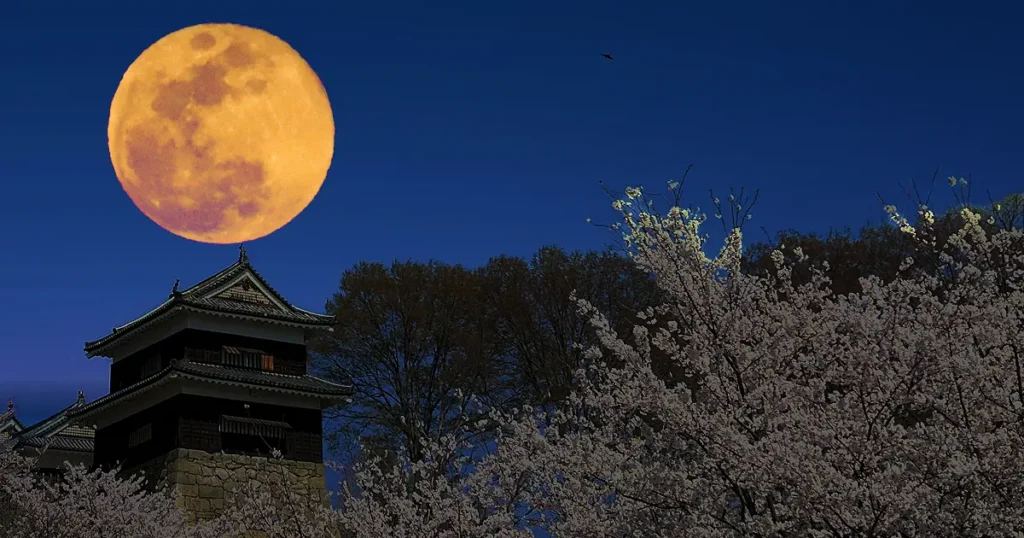
On a small apartment balcony, a low tray has been set out: a short pyramid of white dumplings, a few stalks of pampas grass leaning in a narrow vase, nothing else. The city below continues exactly as it did an hour ago — trains still running, convenience store lights still humming — but on this one balcony, for the next hour, nothing is scheduled to happen at all.
A woman sits down, faces east, and waits. She is not waiting for anything to arrive except the moon, which will do what it has always done, on its own schedule, regardless of whether she is watching.
I. A Fifteenth Night as a Fixed Point
Tsukimi centers on jūgoya, the fifteenth night of the eighth lunar month, when the harvest moon is traditionally at its fullest and brightest. The custom traces back to the Heian court, where aristocrats gathered not simply to look at the moon but to write poetry about it, often preferring to view its reflection in a cup of sake or a still pond rather than the moon itself — a deliberate softening of something already too bright to look at directly for long.
This origin matters, because it frames tsukimi from the start as an act of composed attention rather than passive glancing. The moon was never meant to be a backdrop. It was the entire evening’s subject.
II. The Actual Etiquette
The offerings are specific, and each carries its own logic. Pampas grass, susuki, stands in for the rice stalks not yet ready to harvest, a stand-in prayer for a good crop. The dumplings, tsukimi-dango, are traditionally stacked in a pyramid of fifteen for the fifteenth night — a small architectural echo of the number the evening is named for.
The tray faces the direction the moon will rise, and etiquette holds that the offering should be set out and, ideally, glimpsed by the moon before anyone eats from it — a small act of hosting rather than mere decoration, not unlike setting a good table before a guest one cannot see but knows is coming.
III. The Second Viewing
What surprises most newcomers to the custom is that jūgoya alone is considered incomplete. A second viewing, jūsanya, falls roughly a month later on the thirteenth night, when the moon is intentionally not quite full — slightly waning, slightly imperfect by the standard of the first viewing.
Older etiquette held that to view only the fifteenth night and skip the thirteenth was katami-zuki, “one-sided moon-viewing,” and considered a subtle bad manners — an unwillingness to also receive the moon in its less perfect phase. Fullness alone was never treated as the whole story; the custom insists on a second look, precisely when the moon is no longer at its best.
IV. A Quiet Resistance to Busyness
It is worth naming plainly what tsukimi does not involve: no craft to complete, no destination, no measurable outcome. In a culture often associated abroad with long working hours and relentless productivity, a tradition built entirely around sitting still and watching something that asks nothing of you in return functions almost as a counterweight.
This is not a contradiction so much as a release valve that has existed for centuries — proof that the same culture capable of extraordinary discipline also built, deliberately, an evening whose entire purpose is to require none.
V. A Luxury Available to Anyone
Unlike many seasonal customs that require a particular garden, a particular teahouse, or a particular skill passed down through years of practice, tsukimi asks almost nothing of the person observing it. A window will do. A balcony will do. Convenience store dango, bought on the way home, will do just as well as anything homemade.
This is, in its own quiet way, one of the more democratic luxuries in Japanese seasonal life — not expensive, not exclusive, not gated behind expertise. It only asks for an hour, freely given, to something that will be just as full, or just as imperfect, whether or not anyone is there to see it.
Tsukimi does not ask what you accomplished today. It only asks whether you looked up.
When did you last give an hour of your attention to something beautiful, with no other purpose attached to it at all?


Comments