
Momiji-gari
Chasing the color front across Japan
FOUR SEASONS/AUTUMN | MEGURU STILLNESS JAPAN
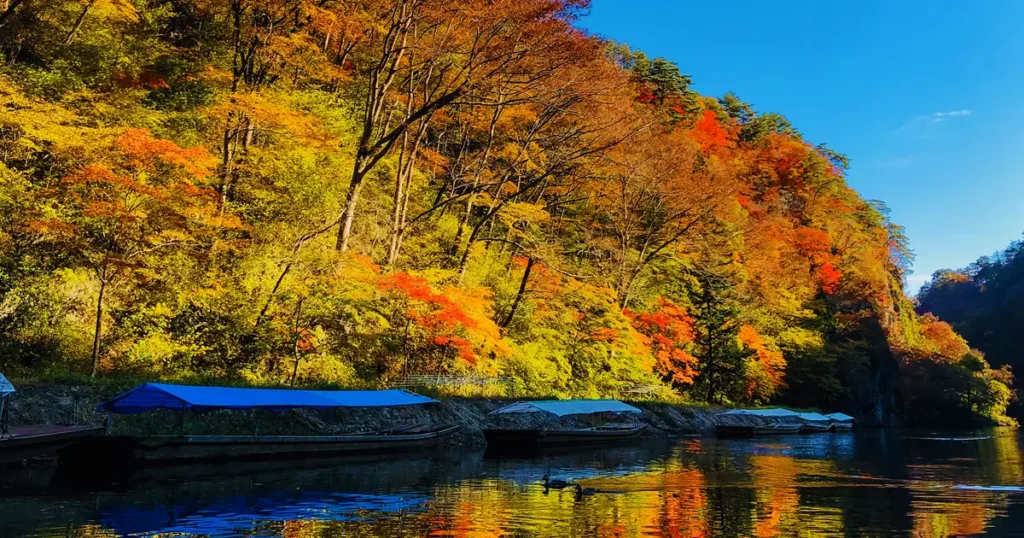
From a train window somewhere in the mountains, the tree line arrives in three distinct bands. At the highest elevation, the maples have already turned — full red, past their peak, some already bare. Just below, a middle band still holds its color at what looks like the exact right moment. Lower still, near the valley floor, the trees remain stubbornly green, as if the message hasn’t reached them yet.
It is the same mountain, the same week, the same species of tree — and three entirely different seasons, stacked one on top of the other, separated only by altitude.
I. Why It Is Called “Hunting”
Momijigari translates literally as “autumn leaf hunting,” and the word is not an accident. Unlike hanami, which largely came to people — cherry trees planted deliberately in castle grounds, riverbanks, and city parks — momijigari historically required people to go out and find it, climbing into mountains and temple valleys where the maples grew wild, well beyond the reach of an evening stroll.
Heian-era aristocrats used the same verb, kari, for this practice as they did for falconry and other genuine hunting expeditions — a small but telling detail. Color, in this tradition, was never something to be waited for at home. It was something to be pursued.
II. Reading the Color Front
Modern Japan tracks this pursuit with the same seriousness it applies to the cherry blossom forecast: the kōyō zensen, or “autumn color front,” charted week by week on national weather sites as it moves across the country. What makes it a genuine counterpart to the sakura forecast — rather than a repeat of it — is its direction.
Cherry blossoms travel north, opening first in the warmer south and reaching Hokkaido last, weeks later. Autumn color reverses the journey entirely, beginning in Hokkaido’s cooler north in late September and taking nearly two months to reach Kyushu in the south. Spring arrives like a wave breaking north. Autumn arrives like the same wave, retreating south.
III. What It Takes to Turn Three Colors
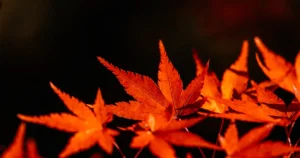
Vivid autumn color is not guaranteed by the calendar; it is the result of a fairly specific set of conditions arriving together. Nights need to turn cold enough, quickly enough, to trigger the trees’ retreat of chlorophyll. Days still need enough sunlight to allow sugars trapped in the leaves to convert into the red pigments responsible for the most dramatic maples. Too much rain, too little cold, or an unusually mild autumn can mute the whole display into a duller yellow-brown.
Elevation compresses this entire process into a single mountainside, which is why the same peak can show three seasons of color on the same October afternoon — the summit already cooling toward winter while the valley floor is still living out the last of summer.
IV. A Different Face in Every Place
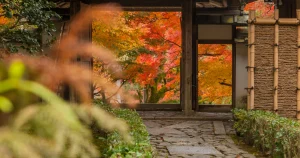
No two regions wear autumn the same way, and this is precisely where a single essay on momijigari has to stop, and a series of place-specific journeys has to begin. A temple garden designed around shakkei, “borrowed scenery,” frames a single curated view of color through a wooden window, controlled and deliberate. A mountain valley offers the opposite — color with no frame at all, spilling unmanaged down a slope in every direction at once. A river gorge adds reflection to the equation, doubling the color on the water’s surface until it is difficult to say where the hillside ends and its own image begins.
Future TABI Destinations
Kyoto’s temple gardens and framed, curated views of color
Nikko’s mountain valleys and their unmanaged, dramatic color
The Tanba basin’s quieter, less-visited color season
A Tohoku route following the color front near its point of origin
V. When the Journey Becomes the Destination
Chasing a color front is, by definition, an act of imprecise planning. The forecast can predict a week, rarely a day, and a sudden storm can strip a mountainside bare before a trip planned months in advance ever arrives. There is no guarantee built into momijigari the way there sometimes is with a museum or a monument that will simply be there, unchanged, whenever you arrive.
What this uncertainty produces, more often than not, is a different kind of attention — travelers checking forecasts the way sailors check weather, adjusting routes at the last moment, treating the destination as a moving target worth following rather than a fixed point worth merely visiting.
You do not schedule a visit to Momijigari. You chase it and hope the mountain is waiting.
What is something in your own life worth chasing precisely because it refuses to wait for you?

Comments