
Shukakusai
A season of public gratitude
FOUR SEASONS/AUTUMN | MEGURU STILLNESS JAPAN
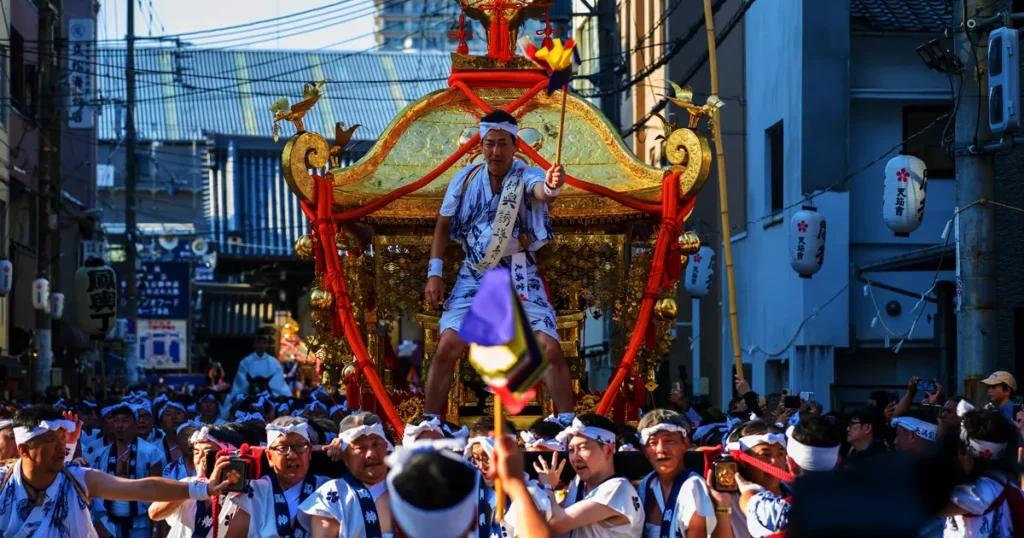
Before the drums start, there is an hour of quieter work: young men in matching happi coats checking the ropes on a mikoshi, an elderly shrine caretaker sweeping a courtyard that is already clean, someone testing a microphone that will announce nothing more complicated than the order of the procession. Then the drums start, and the quiet hour is over.
The portable shrine is lifted onto dozens of shoulders at once, swaying hard from side to side as it moves, deliberately unsteady, carried rather than driven — because a god, tradition holds, should never travel too smoothly.
I. When Gratitude Takes a Physical Form
At its most formal level, this season’s gratitude has a name and a date: Niiname-sai, the harvest thanksgiving rite performed at shrines nationwide and, in its grandest form, by the Emperor himself, offering the year’s first rice to the deities before anyone else — including the imperial household — is permitted to eat it.
But formality is only one register. At the community level, the same instinct — offer the first and best of what was grown before consuming any of it yourself — plays out less as solemn ceremony and more as noise, motion, and shared physical effort.
II. The Festival as a Carrying
Much of what defines a Japanese autumn matsuri is the act of carrying something heavy, together, through the streets. The mikoshi is not paraded so much as hauled — a deliberately effortful, physically demanding task distributed across as many shoulders as the shrine can recruit, taiko drums setting a pace no single person controls.
This matters because it marks a clear departure from the quieter, more solitary autumn rituals already covered elsewhere in this series. Tsukimi asks for stillness. A harvest festival asks for exactly the opposite — for gratitude to be loud, physical, and shared by as many bodies as possible at once.
II. A Different Face in Every Region
Harvest gratitude does not look the same twice. In Japan’s major rice-growing regions — the plains of Niigata and Akita among them — autumn festivals often stay close to the crop itself, built around the rice harvest with a directness that borders on the literal. Elsewhere, the same underlying gratitude takes far more theatrical form: Himeji’s Nada Fighting Festival sends mikoshi crashing into one another as a display of vigor rather than delicacy, while old shrine processions in Kyoto lean toward pageantry and historical costume rather than raw physical contest.
Future TABI Destinations — Linked from This Article
- The rice-growing plains of Niigata and Akita, and their harvest-season festivals
- Himeji’s Nada Fighting Festival and its clashing mikoshi
- Kyoto’s old shrine processions and historical pageantry
- Small mountain-village harvest and fire festivals in Tohoku
Each of these deserves its own dedicated TABI journey rather than a summary here — this article’s role is to establish why harvest festivals differ so much by region in the first place, so that the destination pieces can go straight to the specifics.
IV. Festival as Labor
What a visitor sees on the festival day is the smallest part of the effort. For weeks beforehand, community members repair floats, retrain drummers who have not played since last year, and rehearse a mikoshi route through streets that will be closed to traffic for exactly one afternoon.
There is a quiet symmetry in this that is easy to miss: a festival thanking the community for a season of agricultural labor is itself produced by weeks of unpaid, largely unseen labor — gratitude, it turns out, does not arrive by itself. Someone has to carry it, literally, on their shoulders.
V. Gratitude That Cannot Be Kept to Oneself
A farmer could, in principle, give private thanks for a good harvest — a quiet moment alone at a home shrine, unwitnessed by anyone. That this culture instead built loud, communal, physically demanding festivals around the same impulse suggests something particular about how gratitude is understood here: not as a private transaction between an individual and fortune, but as something that properly belongs to an entire community, carried together or not carried at all.
A harvest festival does not simply celebrate what the land gave. It insists that no one thank it alone.
Is there a gratitude in your own life that you have been keeping quiet, which might actually be meant to be shared out loud?


Comments