
TABI – The Journey of Stillness
丹波
TANBA
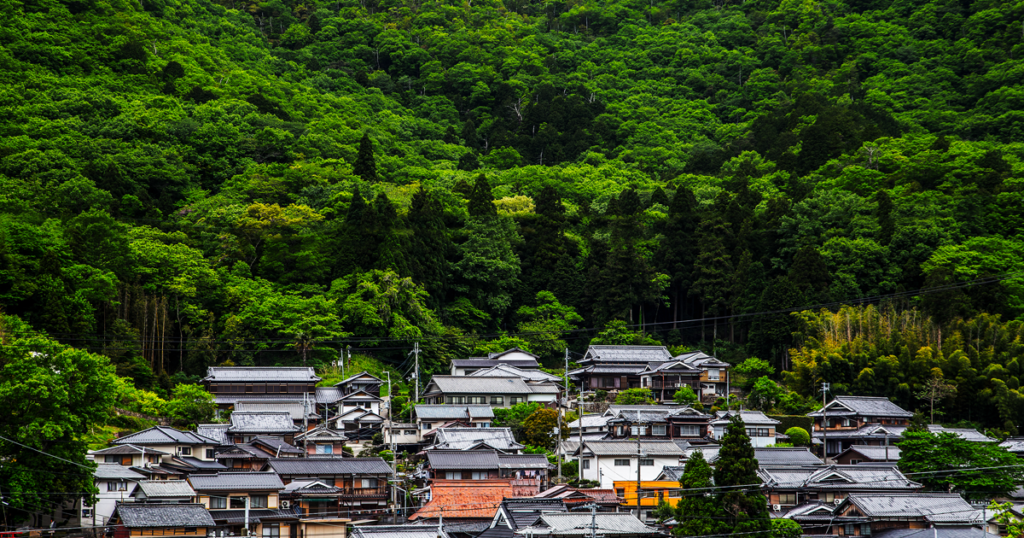
The valley does not appear all at once. It arrives in pieces, through a fog so thick and so ordinary to this particular basin that it has its own name — Tanba-giri, the Tanba mist — rolling low over rice fields until a rooftop, then a tree line, then a single farmhouse light, surfaces from the white.
By mid-morning it will have burned off entirely, and no one arriving after nine o’clock will believe it happened. But for those first hours, Tanba belongs to a version of itself that only the earliest risers ever see.
I. A Land Made by Its Own Fog
Tanba’s mist is not a poetic exaggeration; it is a direct consequence of geography. The basin sits ringed by low mountains that trap cool night air beneath the warmer air above, and the temperature difference condenses into fog nearly every clear morning, especially in autumn. It is, in effect, a landscape that manufactures its own atmosphere.
This same enclosed geography — the trapped air, the mineral-rich soil left behind by an ancient inland lake — turns out to explain far more about Tanba than its weather alone.
II. Why Pottery Was Born Here
The reddish, iron-rich clay beneath Tachikui was once a lakebed, compressed over millennia into something dense enough to survive the intense heat of an anagama kiln. Add the abundant red pine of the surrounding hills, burning hot and long enough to fire that clay properly, and a nearby river route to move finished jars toward Kyoto and Osaka — and the emergence of one of Japan’s Six Ancient Kilns here stops looking like chance.
Readers who have spent time with our article on Tachikui-yaki will recognize the clay, the kilns, and the folk-craft philosophy behind them. What follows here is the land those objects came from — the valley itself, rather than what is made in it.
III. A Land That Gives Generously
The same fog and mineral soil that shaped the clay also shape what grows here. Tanba black soybeans, larger and sweeter than most varieties, are harvested in late autumn and treated less like a side dish than a delicacy in their own right. Tanba chestnuts follow soon after, and in the colder months, botan-nabe — wild boar hot pot — draws people to small mountain inns for a meal built around the season’s most honest ingredient: whatever the land and its forests were willing to give that year.
IV. Walking the Old Castle Town
Sasayama’s castle town has kept its Edo-period bones largely intact: a grid of low wooden merchant houses, a preserved samurai residence district, storefronts that have sold the same handful of local goods for generations. Walking here is less about seeing individual sights and more about matching your pace to the town’s, which has never been in a hurry.
Despite its unhurried character, Tanba is not remote. It sits within easy reach of all three major Kansai hubs — roughly an hour from Kobe or Osaka by car or train, and not much further from Kyoto — which makes it equally suited to a quiet day trip or the first stop on a longer journey through the region.
In recent years, Tanba has also begun investing seriously in overnight stays — restored machiya townhouses converted into small guesthouses, and inns built around slow mornings rather than packed itineraries — giving visitors a reason to stay past sunset rather than simply pass through.
V. The Luxury of Nothing Happening
There is no single monument in Tanba built to overwhelm you. No sight demands an hour of queuing or a checklist to be completed. What the valley offers instead is something harder to market and easier to undervalue: permission to let an afternoon pass with nothing scheduled in it.
That kind of stillness cannot be scheduled into a fifteen-minute stop between other destinations. It asks, gently, for a little more time than that — which is precisely why it rewards those who give it.
Tanba has nothing to show you. It only has time to give you, which turns out to be harder to find.
If an unclaimed afternoon ever opens up somewhere in Kansai — between Kobe, Osaka, and Kyoto, closer than it looks on the map — let it lead you here. Not to see something in particular. Just to let an hour pass without needing to fill it, in a valley that has been practicing exactly that for a very long time.

Comments