
秋
AKI — AUTUMN
Prologue
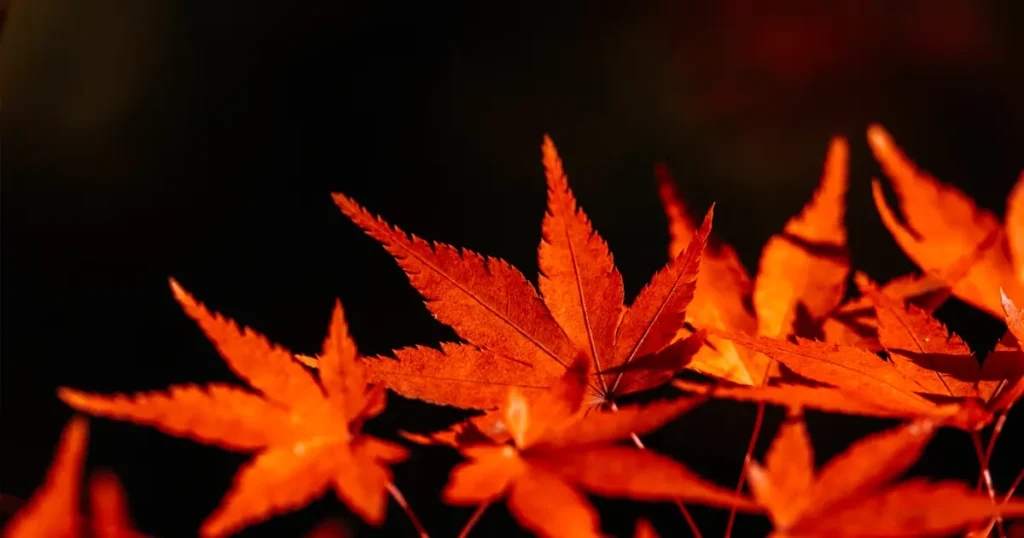
The change announces itself in the mornings first — a coolness at the edge of the air that was not there the day before, arriving without ceremony, as if it had simply been waiting its turn. The cicadas, which for months insisted on being heard, grow quiet one by one, and into that new silence steps something smaller: a single cricket, calling from somewhere near the ground.
A single maple leaf turns red on an otherwise green tree, days or weeks ahead of the rest. No one plants it there; it simply announces, alone, that everything else will soon follow.
I. The Turning Light
Autumn light in Japan carries a particular slant — lower, longer, less certain of itself than the flat brightness of summer. It falls sideways through the trees rather than down through them, catching the underside of leaves before it catches their surface.
This is the season that photographers wait all year for, and yet no photograph quite holds it. Something about the light itself seems to know it is temporary, and that knowledge changes how it falls.
II. A Grammar of Impermanence
Wabi-sabi is often introduced to outsiders as an aesthetic — a taste for the weathered, the asymmetrical, the imperfect. But autumn is where it reveals itself as something closer to a grammar: a way of reading beauty that requires decline to be part of the sentence, not a flaw in it.
A leaf is not any less beautiful despite turning brown at its edges. It is beautiful because of what the browning tells you about the leaf’s position in time — that it has lived, and that living has a direction.
III. Looking Up on Purpose
Tsukimi, moon-viewing, is one of the few traditions in Japan built entirely around doing nothing but looking. No craft is required, no destination, no particular skill — only a clear night, a raised platform or a quiet window, and the willingness to give an hour of attention to something that asks nothing of you in return.
Offerings of rice dumplings and pampas grass are set out less as ritual obligation than as a kind of hosting — as though the moon were a guest, arriving on schedule, and the least one could do was prepare a small table.
IV. The Weight of a Full Harvest
Autumn festivals in Japan are, at their root, gratitude made public. Rice harvested, storerooms filled, a year’s labor made visible in stacked crates and shrine offerings — the community pauses not to celebrate an ending, but to acknowledge that the ending was earned.
There is a particular humility in a harvest festival, one that is easy to miss: it thanks the soil and the weather as much as the people who worked it, as if to say that none of this was owed, only given.
V. The Deepening Quiet
By the season’s later weeks, the crickets too begin to thin, and the quiet that follows is different from summer’s silence — heavier, more deliberate, closer to the stillness of a room after guests have gone home. The trees do not resist the loss of their leaves so much as release them, one small letting-go at a time, as though rehearsing something larger.
Autumn does not ask to be stopped. It asks only to be noticed while it is still leaving.
What in your own life have you learned to find more beautiful because it is fading, rather than despite it?

Comments