
焼物YAKIMONO — Eight Hundred Years of the Same Mountain Valley
MONO/The Tangible Stillness | MEGURU STILLNESS JAPAN
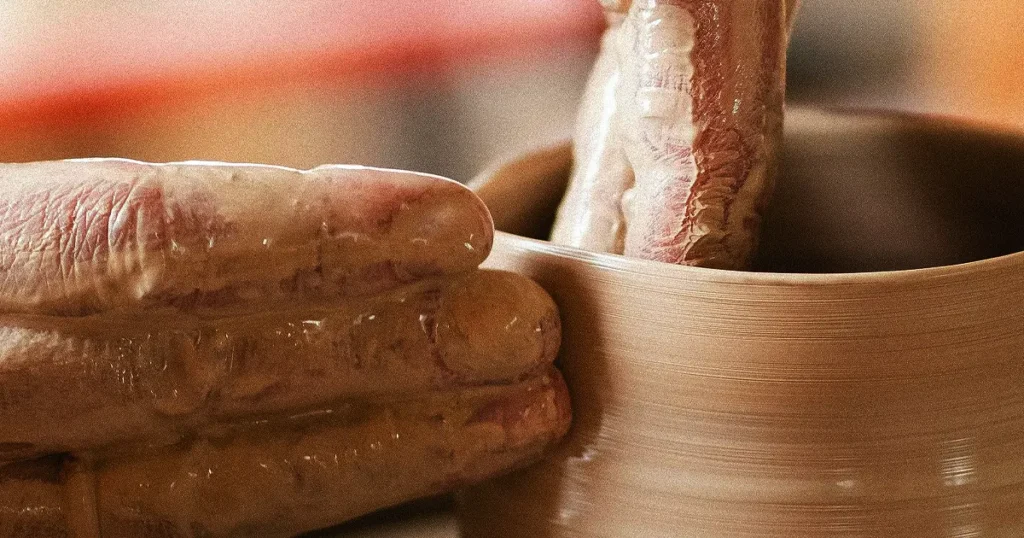
On Tachikui ware, Tamba —
And what it means is that the kilns of Hyogo have never stopped firing.
Smoke was coming from somewhere above the tree line when I turned off the main road into Tachikui.
The village sits tucked into a hillside in what was once the province of Tamba — now part of Hyogo Prefecture, about an hour north of Kobe by car. The road narrows as you approach, the houses press closer together, and then suddenly there are kilns: low, curved structures built into the slope of the hill itself, their chimneys rising above the rooftops of the workshops below. The smoke that morning was pale and thin and smelled of wood and something older than wood.
Potters have been firing clay in this mountain valley since the late twelfth century. The kilns have changed; the fuel has changed; some of the techniques have changed. But the mountain valley has not changed, and the clay beneath it has not changed, and the particular quality of the things made here — heavy, irregular, warm in the hand in a way that has nothing to do with temperature — has not fundamentally changed in eight hundred years.
I have driven out to Tachikui more times than I can easily count. I keep going back for the same reason people keep returning to certain places: because something about them resists being fully understood from a distance, and because each visit reveals something the last one didn’t.
Chapter 1
The six ancient kilns — and why Tamba is the one most people haven’t heard of
There is a designation in Japanese ceramics called the Rokkoyo (六古窯) — the Six Ancient Kilns. These are the six sites where pottery has been produced continuously since before the medieval period, without interruption, using traditions that trace back to the beginnings of Japanese ceramic culture. They are not the only important kiln sites in Japan, but they are the oldest surviving ones, and there is something significant in the fact of their continuity.
Rokkoyo — The Six Ancient Kilns / 六古窯
| Seto The most widely known. “Setomono” became a common word for ceramics in Japanese. | Tokoname Known for teapots and its distinctive red-brown clay. | Echizen Heavy, rugged ware from the Japan Sea coast. Bold and unadorned. |
| Shigaraki Famous for its distinctive orange flame-markings and tanuki figurines. | Bizen Unglazed, iron-rich clay. Prized in the tea ceremony world above almost all others. | Tamba — Tachikui The one closest to Kobe. Iron-rich clay that produces warm browns and quiet grays. Highly regarded in mingei — the folk-craft tradition. |
Of the six, Tamba is probably the least internationally recognized. Bizen has the prestige of the tea masters. Shigaraki has the tourist trade. Seto gave its name to the word for ceramics in Japanese. Tamba has something quieter and, I would argue, more interesting: it has a quality of restraint that only becomes visible when you hold a piece in your hands for long enough.
Chapter 2
What the fire decides
The defining characteristic of Tamba ware — the thing that distinguishes it immediately, even to an untrained eye — is its surface. Not the glaze, though Tamba pieces are often glazed; it is what happens beneath and around and through the glaze that matters. The firing process in a traditional anagama or noborigama kiln produces effects that cannot be fully controlled and cannot be replicated: the gray where ash settled and melted into the clay, the reddish warmth where the flame touched directly, the subtle darkening where heat was uneven.
The vocabulary that Tamba potters use for these effects is itself instructive. The reddish marks left by direct flame contact are called hi-iro (火色) — literally “fire color.” The patterns formed by falling ash are called hai-kaburi (灰かぶり) — “ash draping.” The unpredictable transformations that occur in the kiln, when clay, heat, and time produce something unexpected, are called yo-hen (窯変) — “kiln change.” None of these are words for mistakes. They are words for things that the fire does, which the potter can encourage but cannot command.
| The language of the kiln — 窯の語彙 |
| Hi-iro | The reddish-orange blush was left where the flame touched the surface directly. Each piece carries a unique record of where the fire traveled. | |||
| Hai-kaburi | Patterns formed by wood ash settling on the surface during firing. Where ash melts, it creates a natural glaze of quiet grays and greens. | |||
| Yo-hen | Any unexpected transformation that occurs in the kiln. Not an accident. A collaboration between the potter’s intention and everything that the potter cannot control. | |||
| Keshiki | Literally “scenery” or “landscape.” The word used in tea ceramics to describe the totality of a piece’s surface character — including its imperfections, variations, and history. A crack repaired with kintsugi becomes part of the keshiki. | |||
In most manufacturing cultures, what the process cannot control is called a defect. In Tamba, it is called keshiki — scenery.
Chapter 3
Yanagi, mingei, and the rediscovery of ordinary things
In the 1920s and 1930s, a philosopher and aesthetician named Yanagi Soetsu became one of the most important figures in the reassessment of Japanese craft. At a time when Japan was rapidly industrializing and many traditional crafts were being displaced or devalued, Yanagi argued for something that seemed obvious once stated but had largely been overlooked: that objects made for daily use — bowls, jars, baskets, textiles — possessed a beauty that was distinct from, and in some ways superior to, the beauty of objects made to be exhibited or admired.
He called this beauty mingei (民藝) — literally “the crafts of the people.” And Tamba ware, he argued, was among its finest examples: pottery that had been made for farmers and merchants and households for centuries, without pretension, in service of use rather than display, and that had accumulated, through that unself-conscious purpose, a quality of beauty that more deliberately artistic objects often lacked.
The distinction Yanagi was drawing is not easy to translate into the aesthetic categories more familiar in the West. It is not quite the same as the distinction between fine art and craft, though it rhymes with it. The core of what he was pointing to is something more like: the difference between an object that knows it is beautiful and performs that beauty, and an object that is simply what it is, without self-consciousness — and that, in being fully itself, happens to be beautiful.
A Tamba jar does not try to be beautiful. It tries to hold things. That it happens to be beautiful is almost incidental — the byproduct of eight hundred years of people making things well for reasons that had nothing to do with beauty.
Chapter 4
The weight of it
There is a potter in Tachikui whose workshop I have visited several times. She makes bowls — primarily bowls — and her work has a quality that I have tried to describe to people who haven’t seen it, with limited success. The closest I have come is this: her bowls look like they have always existed.
Not old. Not antique. Just: already there. As if the bowl had been waiting inside the clay for someone with the right hands to find it, rather than made by those hands. This is, I think, what the mingei aesthetic actually feels like when it succeeds — not the look of craft, but the look of something that simply is.
The first time I picked up one of her bowls, I was surprised by the weight. Not heavy — nothing like the dense earthenware of some traditions — but substantial in a way that aligned exactly with the way it looked. The weight was part of the honesty of the thing. This is clay from this hill, the weight was saying. This is what it feels like to hold eight hundred years of someone’s attention to the same material.
When you pick up a Tamba bowl, you are not holding clay. You are holding the accumulated attention of eight hundred years of people who cared about the same mountain valley.
I asked the potter once what she thought about when she was working. She said she thought about the person who would use the bowl. Not a specific person — she didn’t know who that would be. But the idea of a person holding it, using it for something: soup, or tea, or rice, or just sitting on a table with nothing in it. She said that what she was trying to make was something that would feel right to that unknown person, in the moment of use. Not impressive. Not beautiful in an attention-seeking way. Just right.
Chapter 5
Coming to find one
Tachikui is not a difficult place to visit if you are in Kobe, Osaka, or Kyoto. It is an hour or less from all three. The village is small — you can walk between most of the open workshops and galleries in an hour or two — and it is genuinely open to visitors in a way that some craft communities are not. The potters here are accustomed to people arriving without appointments, picking things up, and asking questions.
The best way to find a piece you will keep for a long time is, I think, the simplest: pick things up. Pick up as many pieces as you can. The one that feels different in your hand from the others — heavier in proportion to its size, or somehow more settled, or with a surface that keeps asking you to look at it again — that is probably the right one. The hand knows things that the eye doesn’t, and the knowledge it has about ceramics is faster and more reliable than anything I could tell you about hi-iro or hai-kaburi.
If you cannot visit Tachikui in person — and I understand that for most readers of this, it will be a place you visit once, if ever — the next best thing is to look for work through retailers who know what they are handling. Not every Japanese ceramics seller does. The ones worth finding are the ones who can tell you the name of the potter, something about the firing, and why the particular piece they are showing you is worth attention.
I have a Tamba bowl that I use every morning. It is not the most remarkable piece I own — it is a simple bowl, brown with patches of gray where the ash settled, slightly uneven on one side where the clay shifted before firing. It holds about three hundred milliliters. It is exactly the right size for the way I drink tea in the morning, which is to say: slowly, with both hands, without reading anything.
I bought it on my third visit to Tachikui, from a workshop near the top of the hill. I had picked it up and put it down and picked it up again before I understood why I couldn’t leave it there. The reason, I think, is this: it did not ask anything of me. It made no claim on my attention. It simply sat in my hands and was itself, and that was more than enough.
Eight hundred years of people making bowls for exactly that reason. That is what I hold every morning.
Is there an object you use every day that you have never really looked at — and what would you find if you picked it up and held it long enough to let it tell you what it is?


Comments