
継KINTSUGI — The Crack Is Not the End of the Story
MONO/The Tangible Stillness | MEGURU STILLNESS JAPAN
On kintsugi —
The Japanese practice of repairing broken ceramics with gold and what it reveals about the value of a scar.
The bowl broke on a Tuesday morning in November, dropped from counter height onto tile. Clean break, three pieces, nothing ambiguous about it.
It was a Tamba bowl I had bought in Tachikui — the kind that takes two hands to hold properly, that has a warmth in the clay that has nothing to do with temperature. I had used it every morning for two years. My first instinct, looking at the three pieces on the floor, was the instinct of my culture: this is now garbage.
I stood there for a moment, looking at it. Then I picked up the pieces and put them on the shelf above my desk, where they sat for three weeks while I thought about what to do.
What I did, eventually, was kintsugi.
Chapter 1
What kintsugi actually is — before we get to what it means
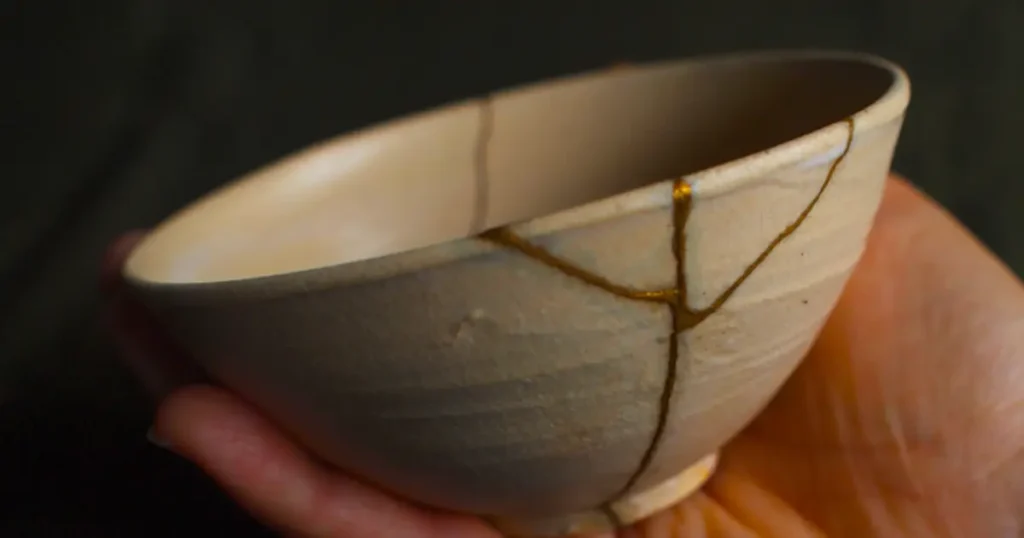
Kintsugi (金継ぎ) is a method of repairing broken ceramics using lacquer mixed with gold powder. The word itself is precise: kin (金) means gold; tsugi (継ぎ) means to join, to continue, to pass on. The repair is not concealed. The repaired lines are made deliberately visible — more visible, in fact, than the original surface — using a material more precious than the object it is mending.
This much, most people who have heard the word already know. What is less commonly understood is the technical reality of doing it properly — the discipline the process actually demands, and why that discipline matters to what the practice means.
There are two versions of kintsugi in circulation today. The first is hon urushi kintsugi — traditional kintsugi, using real lacquer derived from the urushi tree. The second is what might be called convenience kintsugi: epoxy adhesive mixed with gold or brass powder, which can be completed in an afternoon. Both produce something gold-lined. Only one of them is what I want to write about.
Chapter 2
The process, and the patience it requires
Traditional kintsugi is not a weekend project. From the first application of adhesive to the final dusting of gold, the process takes a minimum of several weeks — often longer, depending on humidity, temperature, and the complexity of the break. The reason is the nature of urushi lacquer itself.
01 |Cleaning and fitting
Day 1
The broken edges are cleaned and dry-fitted — assembled without adhesive first, to understand exactly how the pieces align. Old glue, grease, or dust must be fully removed; urushi will not adhere to a contaminated surface.
02 |Mugiurushi — the first bonding
Day 2 — then wait 1–2 weeks
Mugiurushi is urushi lacquer mixed with wheat-starch paste to create an adhesive. It is applied to the broken edges, and the pieces are pressed together and held. Then — and this is the part that most surprises newcomers — it must cure in a muro.
03 |The muro — curing in darkness and humidity
1–2 weeks per layer
Urushi lacquer cures not by drying — it polymerizes through a chemical reaction that requires moisture and warmth. The muro is a humidity chamber: traditionally a wooden box with damp cloths inside, kept at sixty to eighty percent relative humidity. In a dry room, urushi will not cure at all; it will simply remain wet indefinitely. Each layer must spend one to two weeks in the muro before the next can be applied.
04 |Sabi-urushi — filling the seam
Days 14–21 — then wait again
Sabi-urushi — urushi mixed with tonoko powder — is used to fill microscopic irregularities, building up the seam until it is smooth and flush with the surrounding surface. This may require two or three applications, each cured in the muro.
05 |Urushi finishing coats
Days 21–35
One or two thin coats of pure urushi are applied over the filled seam, each cured in the muro, then sanded back to create a surface with exactly the right texture to hold the gold powder.
06 |Makie — dusting with gold
Day 35–42 — final cure
While the final urushi coat is still at the precise point between wet and tacky, fine gold powder is dusted onto the seam with a soft brush. The timing is critical: too wet and the gold sinks; too dry and it won’t adhere. One final stay in the muro. Then it is done.
■On urushi and patience
Why the muro matters
The muro is not simply a practical requirement. It is where the meaning of kintsugi is most concentrated. The broken bowl must spend weeks in a dark, humid box before it can become something new. It cannot be hurried. It cannot be substituted. The waiting is part of what the repair is — and it is the part that the epoxy version, however well-intentioned, cannot replicate.
Chapter 3
Keshiki — the scar that becomes scenery
In the world of Japanese tea ceramics, the repaired lines of a kintsugi bowl are not regarded as evidence of damage. They are regarded as keshiki — scenery. The same word is used in Tamba for the surface character created by the fire: the totality of what the object has been through, made visible.
This is not the same thing as saying that breakage is beautiful. The bowl is not beautiful because it broke. It is beautiful despite the break, and through it, and after it — because the decision was made not to end the story at the moment of fracture, but to continue it, and to make that continuation part of what the object visibly is.
The bowl was worth repairing. That decision, made once, changes everything the bowl subsequently is.
There is a distinction I want to make carefully, because it is the one most often lost when kintsugi circulates in Western popular culture. The gold is not the point. The gold is the marker — the signal that says: here is where this thing was broken, and here is where it was put back together, and neither of these facts is being hidden from you. Honesty is the point. The gold is simply how that honesty is made visible.
In North America, kintsugi has become a metaphor — and a popular one, for good reason. The idea that people, too, can be made more whole at their broken places has genuine power. But the metaphor can become a way of consuming the philosophy without inhabiting it. The practice of actual kintsugi, with actual urushi and actual weeks in the dark, asks something different from you than the metaphor does.
Chapter 4
Two philosophies of damage — and why kintsugi isn’t optimism
Kintsugi is sometimes described as a philosophy of resilience: broken things become stronger or more beautiful through repair. I understand why this framing is appealing, but I think it misrepresents what the practice is actually doing.
| WESTER “RESILIENCE” READING Damage as something to overcome The break is an obstacle. Repair is recovery. The goal is to become whole again — ideally stronger than before. The narrative moves toward restoration. | KINTSUGI’S ACTUAL PREMISE Damage is something that happened The break is a fact. Repair is continuation. The goal is not to become whole again but to become what you are now, after the break — honestly, without pretending it didn’t occur. The narrative doesn’t move toward restoration; it incorporates. |
This is not a small distinction. The resilience reading is essentially forward-looking: the damage is a setback on the way to a better state. The kintsugi premise is neither forward nor backward-looking: the damage is now part of what the object is, carried forward not as a wound but as a record. The repaired bowl is not stronger than the unbroken one. It is different — and the difference is not concealed.
This is the point at which kintsugi most clearly connects to Zen — specifically to the concept of mushin (無心), the state of “no-mind” that is not the absence of experience but the absence of resistance to it. The Zen practitioner does not try to prevent difficult experiences or overcome them; they try to move through them without adding a story about what they mean. Kintsugi does something similar with objects: it moves through the break without calling it a disaster, without calling it a triumph, without calling it anything other than what it is.
Chapter 5
The bowl I repaired, and what it became
The Tamba bowl took six weeks to repair. I used a beginner’s traditional kintsugi kit — real urushi, though pre-prepared in a way that makes it somewhat more forgiving than raw lacquer — and I made mistakes. The seam on one side is slightly raised where I applied too much sabi-urushi. The gold line on the smallest piece is thinner than the others because I ran out of gold powder and had to use the last of it carefully.
The bowl is imperfect in new ways that it was not imperfect before. The raised seam catches my thumb in the morning in a way the original surface didn’t. The thin gold line is visible once you know where to look. These things did not bother me in the way I expected them to. What I noticed instead, the first morning I used it after the repair, was that I held it differently. More carefully. More consciously. I had spent six weeks bringing it back — something had changed in my relationship to it that I could not quite name, but that was present in the way I held it.
That change is what I think kintsugi is actually producing when it is done with real materials and real time. Not a more beautiful object, necessarily. Not a stronger one. A different relationship between a person and a thing — one in which the history of the thing is fully acknowledged, and the choice to continue is made visible, in gold, on the surface of the object every time you hold it.
The bowl is still in my kitchen. I use it every morning, the way I always did — both hands, slowly, without reading anything. The gold lines catch the light differently depending on the angle, and which one is thinnest depends on where you’re standing when you look.
I know exactly where it broke. I know which piece was which. I know which seam is slightly raised and why. None of this is visible in a way that would bother someone who didn’t know the history. All of it is visible to me, every morning, in the way I hold it.
That is the practice: not a philosophy you hold in your head, but a material fact you hold in your hands.
Is there something broken in your home that you have not yet decided what to do with — and what would it mean to spend six weeks bringing it back?

Comments