On the Japanese practice of ojigi — and what bowing reveals about the architecture of respect
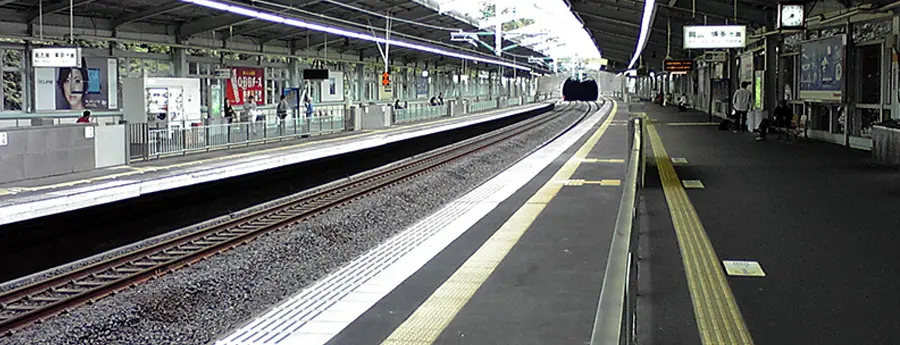
The shinkansen had already rounded the curve and disappeared when I noticed the conductor was still bowing.
He stood at the edge of the platform — back straight, torso folded forward at precisely thirty degrees, eyes cast toward the concrete — and he held that position for what seemed, by the standards of any culture I had previously inhabited, an unreasonable amount of time. The last car of the train was gone. The passengers he had been addressing were now somewhere beneath the mountain, moving toward Osaka at three hundred kilometers per hour. There was no one left to receive his bow.
Even so, he continued to maintain that stance.
I have lived near Kobe for long enough now that I no longer find this unusual. But that morning on the platform, I found myself unable to move. I missed the escalator. I stood and watched a man bow to the memory of a departed train, and something shifted in my understanding of what respect actually is.
Chapter 1
The geometry of regard
Ojigi — the Japanese bow — is often described to foreigners as a form of greeting, a substitute for the handshake. This is accurate in the same way that describing music as “organized sound” is accurate. It is technically correct and almost entirely beside the point.
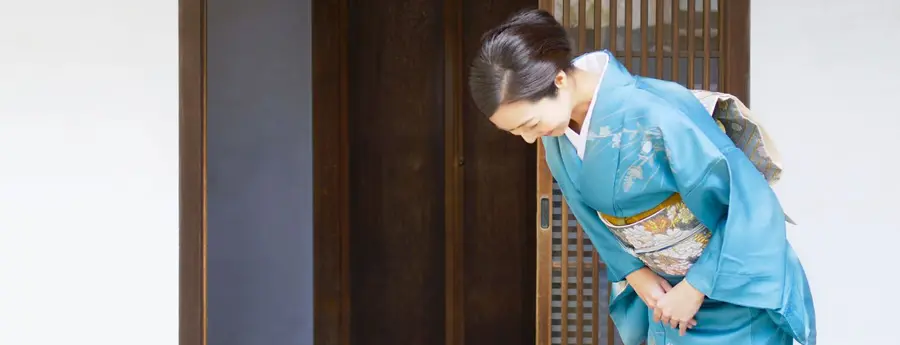
What ojigi actually is a precise physical language. Every angle carries meaning. A casual fifteen-degree incline — the head dipped slightly, the gaze lowered — is a passing acknowledgment, the equivalent of a nod between neighbors. Thirty degrees signals genuine respect: the standard bow of business, of entering a room, of receiving something offered with both hands. At forty-five degrees, the language shifts toward apology or deep gratitude — a bow you give when words are not sufficient. And then there is the ninety-degree bow, the full fold at the waist, which is reserved for moments when the body needs to make a statement that the voice cannot.
In a culture where “I’m sorry” and “thank you” are often spoken with the same word — sumimasen contains both — it is the angle of the body that carries the emotional weight.
What interests me is not the taxonomy of angles, though. It is what happens in the space the bow creates.
What interests me is not the taxonomy of angles, though. It is what happens in the space the bow creates.
Chapter 2
A different architecture of encounter
In the cultures I grew up around, eye contact during a greeting is proof of sincerity. You look someone in the eye when you shake their hand; you hold their gaze while you thank them. To look away is to be evasive, or distracted, or perhaps dishonest. The face turned toward you is the whole point.
Ojigi inverts this entirely.
When two people bow to each other in Japan, both lower their eyes simultaneously. Both look toward the ground. For a moment — sometimes a long one — there is no eye contact at all. Each person has, in a sense, turned away from the other at the very moment of acknowledgment.
I spent a long time thinking this was a kind of modesty or social deference. But I’ve come to understand it differently now. The bow doesn’t turn you away from the other person. It creates a shared space between you — a moment that belongs to neither of you individually, that exists only in the meeting. The lowered eyes are not avoidance. Their attention is directed inward: to the quality of your own regard, to the sincerity you are trying to offer.
The handshake says ― I see you.
The bow says ― I am present with you.
These are not the same thing, and the difference matters more than it might first appear.
Chapter 3
Ma — the space that isn’t empty
There is a Japanese concept called ma (間) that I find myself returning to whenever I try to understand ojigi. It is usually translated as “negative space” or “pause,” but these translations lose something essential. Ma is not the absence of something. It is the active presence of a gap — the silence between notes that gives music its shape, the space between walls that makes a room inhabitable, the breath between words that makes a sentence mean something.
The moment of the bow is ma made physical.
When a conductor on a train platform holds his bow past the point where anyone is watching, he is not performing for an audience. He is completing a form — giving a shape to the moment of departure as precisely as a calligrapher gives shape to the last stroke of a character. To cut the bow short because no one is watching would be the equivalent of trailing off mid-sentence because the listener had left the room. The form exists independently of its witness.
This is, I think, what I did not understand that morning on the platform. I was looking for someone to receive the bow. But the bow was not primarily about reception. It was about the quality of the attention being paid.
Chapter 4
The body that bows before the mind decides
There is a particular thing that happens after you have lived in Japan for long enough. You begin to bow in situations where bowing makes no practical sense.
You bow to the person at the other end of a telephone call. You bow when you walk out of a convenience store alone, head inclined slightly toward the door you’ve just passed through. You bow when you receive an email with good news, to no one, in an empty room.
The first time I caught myself doing this, I felt mildly embarrassed. The second time, I felt curious. By the third or fourth time, I had started to understand something.
The bow that happens before you think about bowing is not a social performance. It is the body expressing something the mind hasn’t yet had time to articulate — a reflex of regard that has been practiced so thoroughly it no longer needs a reason. It runs beneath language. It runs beneath intention.
And there is something in that depth that I find myself envying, even as someone who came to Japan as an adult and will never fully inhabit this bodily grammar. The idea that respect could be so thoroughly practiced that it becomes involuntary — that gratitude could be stored in the spine rather than the prefrontal cortex — feels like a different relationship to one’s own inner life than I was raised to have.
Chapter 5
What the bow cannot be translated into
I am aware, as I write this, that ojigi is easy to romanticize. Japan contains, like every society, a full spectrum of insincerity — of bows performed without feeling, of social obligations discharged with the body while the mind is elsewhere. The form does not guarantee the content.
But the form exists. And forms shape the people who inhabit them, over time, in ways that are difficult to see from the outside.
What I find most difficult to carry across into English is not the word ojigi, nor even the concept of ma. What is hardest to translate is the underlying assumption: that the body is a legitimate site of ethical practice. That how you hold yourself in space — the angle of your spine, the direction of your eyes, the precise moment at which you rise from a bow — is a form of moral expression, not a decoration applied over it.
In a culture that tends to locate morality in intention and belief, this is a genuinely strange idea. That a man standing alone on a platform, bowing to a train that has already disappeared, might be doing something ethically serious — that the form of his attention is itself a kind of action — requires a reorientation that is difficult to describe and easy to overlook.
I still think about that conductor sometimes, when I find myself rushing through a door without pausing, or answering a call before I’ve settled into the attention the other person deserves.
I don’t know if his bow meant something to him in that moment, or if it had long since dissolved into the muscular memory of ten thousand platform departures. Perhaps both things can be true at once.
What I do know is this: the train was gone, and he was still holding the shape of his regard for it. The bow outlasted its occasion. And in that small excess — that refusal to cut the form short the moment it became unnecessary — there was something I have not been able to stop thinking about.
When was the last time you gave your attention to something past the point where it was watching you back?

Comments