
刀KATANA 刃物HAMONO — The Town That Never Stopped Sharpening
MONO/The Tangible Stillness | MEGURU STILLNESS JAPAN
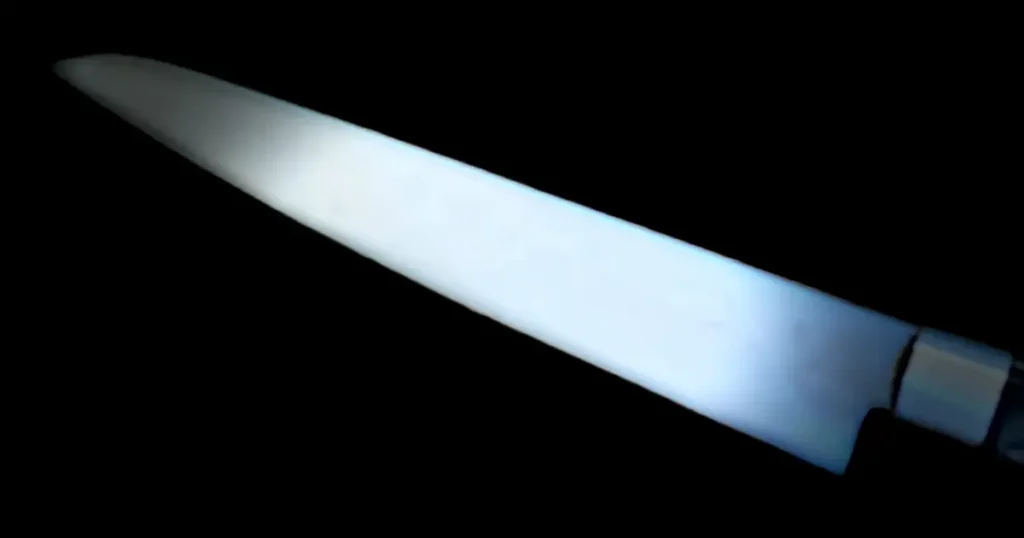
The sound came before anything else — a rhythmic, metallic ringing that I felt in my sternum before I understood what I was hearing.
I was standing in a narrow street in Miki, a small city forty minutes east of Kobe, and somewhere behind a sliding door, someone was forging steel. The door was shut. There was no sign. There was nothing to indicate that the building in front of me was anything other than an ordinary house in an ordinary street, except for that sound — patient, precise, and very old.
I stood there for longer than was probably polite. I was not the first person to stand on this street and listen. People have been forging blades in Miki for roughly seven hundred years.
Chapter 1
From sword to kitchen — the long peace and what it made
Miki’s history as a blade town begins, like much of Japanese craft history, with war. The region had skilled metalworkers long before the sixteenth century, but it was the aftermath of the Battle of Miki in 1580 — a brutal ten-month siege led by Toyotomi Hideyoshi that left the town in ruins — that paradoxically set the foundation for everything that followed.
The reconstruction of Miki required carpenters and craftsmen from across the region, all of whom needed tools. The local smiths who supplied those tools — chisels, planes, saws — developed reputations that spread beyond the province. By the Edo period, when Japan entered its long era of enforced peace under the Tokugawa shogunate, the sword-makers faced a crisis: the principal market for their primary product had essentially vanished.
What they did next is, I think, one of the more elegant pivots in the history of craft. Rather than abandoning their knowledge of steel, they redirected it — toward planes for carpenters, chisels for joiners, knives for farmers and cooks. The same understanding of hardness, temper, and edge geometry that had made swords stayed intact. Only the destination changed.
The sword became the kitchen knife the way a river becomes the sea: gradually, without announcing itself, carrying everything forward.
Today, Miki produces an estimated ninety percent of Japan’s professional-grade carpentry tools, and its kitchen knives are carried by chefs on every inhabited continent. The town of roughly seventy thousand people contains, by my rough count, more than a hundred active blade manufacturers — from small family workshops with two or three craftsmen to larger operations with dozens of employees. What unites them is not size or style, but a shared inheritance of technical knowledge that has been passed down, adjusted, and refined for seven centuries.
Chapter 2
The philosophy of steel
If you ask a Miki bladesmith what makes a good knife, the answer will not, at first, sound like an answer. You will hear about steel. About the difference between hardness and toughness — how a blade that is too hard will be brittle, how a blade that is too soft will not hold an edge. You will hear about the temperature of the forge and how it must be read by the color of the fire, not a thermometer. You will hear, eventually, about the ground.
The Japanese knife-making tradition distinguishes between several types of steel, each suited to a different relationship between maker, user, and task. Understanding these distinctions is not merely technical — it is, in miniature, a way of thinking about what a tool is supposed to be.
| Steel | Character | Best suited for |
| Shirogami — White Steel | Extremely pure carbon steel. Takes the sharpest edge of any Japanese steel; also the most demanding to maintain. | Experienced cooks who sharpen regularly. A knife that rewards attention. |
| Aogami — Blue Steel | Carbon steel with added tungsten and chromium. Slightly more forgiving than white steel; retains its edge longer under regular use. | Home cooks moving toward serious knife work. Balance of performance and practicality. |
| Stainless Clad | High-carbon core sandwiched in stainless. Rust-resistant; easier to maintain without sacrificing the performance of a quality edge. | Most home kitchens. Entry point into Japanese knife quality without a steep learning curve. |
What the table above cannot convey is the underlying philosophy that determines which steel is right for a given person. In Miki’s craft tradition, a knife is not a finished object — it is an ongoing relationship. The white steel knife that demands weekly sharpening is not a worse knife than the stainless-clad one that tolerates neglect; it is a different kind of commitment. The assumption is that the person holding the knife will grow into it, will learn to maintain it, will, over years, develop a relationship with a particular blade the way you develop a relationship with a person: through repeated attention, through small corrections, through time.
Chapter 3
What the hands know
The forge I stood outside that morning belongs to a family that has been making blades for four generations. The current master — a man in his late fifties, with hands that looked like they had been carved from the same material he worked with — was reluctant to talk at first. Not unfriendly. Just precise in his estimation of what words could and could not accomplish.
Eventually he showed me the process. Not as a performance — he had work to do, and I was permitted to watch while he did it — but as a fact. This is what making a blade requires. Here is the fire. Here is where you read the color. Here is the moment — and he paused at this, looking at the steel in the forge — here is the moment that cannot be measured.
The moment he was referring to is the point at which heated steel must be quenched — plunged into water or oil to lock in the hardness achieved at high temperature. Go too early and the steel will be soft. Go too late and it will be brittle. The correct moment is identified by the color of the steel: a particular shade of orange, distinct from the orange before it and the orange after it, which experienced smiths learn to read over years of looking.
There is no instrument that can replace this knowledge. There are thermometers, and experienced smiths use them as reference points, but the decisive reading is done with the eyes. The knowledge lives in the body of the craftsman, accumulated over thousands of repetitions, and it does not transfer cleanly into language or numbers. This is what people mean when they say a craft is dying: not that the tools have disappeared, but that the eyes trained to read that color are growing fewer.
FROM STEEL TO BLADE – THE MAKING
01|Selecting the steel / 鋼の選択
The choice of steel determines everything that follows. In Miki, this decision is made based on the intended use and the experience level of the eventual user.
02|Forging / 鍛造
Steel is heated to approximately 1,200°C and hammered into shape. The hammering is not merely forming — it is compressing and aligning the grain structure of the metal, directly affecting the blade’s performance.
03|Quenching / 焼き入れ
The moment that cannot be measured. Steel is plunged into water or oil at the precise instant — read by color — when maximum hardness can be locked in without brittleness.
04|Tempering / 焼き戻し
Reheating at a lower temperature reduces brittleness while retaining hardness. The balance between these two qualities — the tension between hard and tough — is where the skill of the smith most clearly resides.
05|Grinding and sharpening / 研削・刃付け
The final geometry of the blade is established. This stage, perhaps more than any other, cannot be automated — the angle, taper, and final edge are shaped through sustained physical contact between craftsman and steel, guided by accumulated tactile memory.
Chapter 4
The knife that grows smaller
There is a concept embedded in the way Miki’s craftsmen talk about their knives that has no direct equivalent in the consumer culture I grew up in. It is the understanding that a knife, properly cared for, will be used until it is gone.
Every sharpening removes a small amount of steel. Over months and years of regular sharpening, a knife that began as a twenty-centimeter gyuto will gradually become eighteen, then sixteen, then something else entirely — smaller, lighter, worn into a shape that reflects the particular habits of the person who has used it. The handle will darken with oil from the hand. The blade will develop a patina specific to the foods it has cut and the water it has been washed in.
This is not deterioration. This is a knife becoming more itself.
A new knife is a possibility. A used knife is a record.
In North America, this relationship to objects is unusual enough to require explanation. We are accustomed to products that are designed to be replaced — that are, in fact, designed to become obsolete so that their successors can be sold. The idea that an object might improve through use, that its value might increase as it conforms more precisely to the person who uses it, is genuinely countercultural in a consumer economy. In Miki, it is simply how knives work.
Chapter 5
The question of succession
The craftsman I visited that morning has one son, who works in a different industry in Osaka. He did not say this as a complaint. He said it as a fact, in the same tone he had used to describe the color of the steel at quenching: here is something that is the case, that cannot be adjusted by wishing it otherwise.
Miki has, in recent years, attracted a small number of young craftsmen from outside the traditional apprenticeship system — people drawn by the craft itself, who learned about it through the internet, who came to this small city because of a quality of attention they wanted to inhabit. This is both encouraging and insufficient. The knowledge held in a single experienced body represents decades of accumulated perception; it cannot be fully transferred in any apprenticeship shorter than a career.
I am aware that pointing this out in the context of encouraging people to buy Japanese knives risks a particular kind of sentimentality — the aestheticization of scarcity, the romanticization of decline. I don’t want to do that. What I want to say is simpler: that these objects exist, that they are made by specific people in a specific place using knowledge that took centuries to develop, and that choosing to own one is, among other things, a choice to be part of that continuity.
What is the oldest thing you use every day — and do you know who made it, or where it came from?

Comments